Showing posts with label poetry. Show all posts

Wednesday, February 28, 2018

The Fire This Time


Before the end of the month, I wanted to mention the final book I read for Black History Month, The Fire This Time: A New Generation Speaks about Race, edited by Jesmyn Ward. I know that this is a current sort of book, talking about the Black experience and psyche in today's America but I do feel that reading about what happened yesterday is just as important as studying what happened in 1965. This collection of essays and poems range from topics such as slavery and police profiling, to family and music. Together, they begin to paint a picture of the required mindset and physical realities of being Black in America today.

There were so many beautiful and sorrowful pieces in this book. There were small glimmers of hope for a better future, especially for today's children, but these were all also tempered with a dose of reality. I personally found it to be a call to action -- both to be a better and truer ally to communities of color and to work harder to change the system through civil and political action so that everyone can truly know that they "have a right to be here" (Edwidge Danticat).

With a heavy heart,
K

Monday, February 3, 2014

Tales of a Feather


The Emperor's Nightingale and Other Feathery Tales is a collection of avian poetry and stories, gathered and illustrated by Jane Ray. It's a gorgeously bright and (mostly) happy collection of morals and whimsy, from sources ranging from the Brothers Grimm to the Bible. While, of course, she must leave poetry as is, Ray retells the stories and fables at a clear and easy-reading elementary school level. It seems a bit strange to begin with a tragic tale (The Happy Prince by Oscar Wilde) but she then moves through such a variety of emotions and time periods and experiences and locations that it demonstrates just how deeply birds are integrated into the stories and myths of all cultures, both in moments joyous and tragic. Birds can be friends, former lovers, saviors and fools. They are creatures of such variety that they lend themselves well as stand-ins for ourselves in almost every situation from the commonplace to the divine.
He was warm and comfortable, nestled among soft feathers and lulled to sleep by the hushing sound of the great creature's wings as they soared among the stars. -- The Firebird
It appears from the introduction that Ray intends to have other themed collections and I think these, starting with this one, would make beautiful library and gift books worthy of any library.

From wing to tale,
K

Disclosure: I received this book from the publisher in exchange for an honest review.

Saturday, October 12, 2013

Read-a-thon Hour Five Update

Good morning all! I'm about to start reading but, in keeping with my plan, I'm also participating in a mini-challenge: Capricious Reader's Spine Poetry challenge!

In keeping with the season, I've made it a spooky one ...


Now off to Which Witch? and a little breakfast ...
K

Friday, August 30, 2013

New Release: A Fatal Likeness


I was very excited to receive an ARC of A Fatal Likeness by Lynn Shepherd this summer and I read it almost immediately and then forgot to note the release date. I just looked today and, well, it came out last week! So now I get to tell you about this second book of Charles Maddox, young detective (the first being The Solitary House). This time, Charles is contacted by the son and daughter-in-law of Mary Shelley, told that he is being hired to investigate the veracity of papers that could be used to dim the brilliant legacy of Percy Bysshe Shelley. The story journeys through time and space to review some of the relationships between the Shelleys, their families and friends and to cast a light on some of their more questionable actions.

I will admit that I only know the bare minimum about the Shelleys and Byron, mostly from works of fiction or as side-notes in non-fiction about other subjects. I have heard that some readers are taking issue, accusing Shepherd of taking liberties with the history and painting the Shelleys with a darker brush than history warrants. However, I didn't feel that they were made into villains so much as being shown as victims of their own eccentricities and maladies. If that was exaggerated at any point to make them seem criminal, I still understood that it was in a fictional context and didn't take offense.

Of course this book has its own protagonist, though I found Maddox's role in this story to actually be somewhat minimal. Still, I saw character growth and I am very interested to see where his character is headed if Shepherd continues writing about him (which I kind of think she has to from where she left his personal story). The bottom line is that I enjoyed the first Maddox novel more but I thought this one was interesting and just as strong in research and construction as the first. But I do like Shepherd's foray into fiction (Dickens and Collins) better because there wasn't so much questioning of whether she had accurately represented her historical figures and done right by them.

Avoiding those both treacherous and fatal,
K

Monday, April 8, 2013

Fun With Poetry, Penguin Style


April is National Poetry Month and Penguin is celebrating with a new iOS app -- Poems By Heart. It's a free download with two poems already loaded onto it and you can buy more packs of 4 poems for 99 cents each. Z and I chose the Adventures and Gothic Tales packs, including poems by Samuel Taylor Coleridge, Edward Lear, Percy Bysshe Shelley, Edgar Allan Poe, Lewis Carroll, Dante Alighieri and Alfred Tennyson.


First the app reads you the poem in a pleasant voice (you can choose male or female). Then you start the steps to memorizing the poem, concluding with recording a poem recitation. Each poem has a rank from EASY to VERY HARD based on, from what I can tell, vocabulary and length. Z and I have decided to be ambitious and try to memorize Jabberwocky (hard) and The Raven (very hard). These are two of our favorite poems ever but we've only ever memorized stanzas. This is going to be fun!

'Twas brillig and the slithy toves,
K
(Once upon a midnight dreary,
Z)

Sunday, October 9, 2011

Fragile Things Group Read: Four Stories (Includes Poem-ish Things)


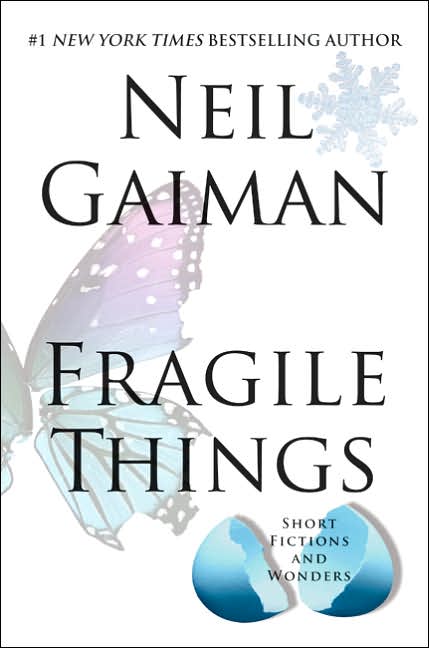
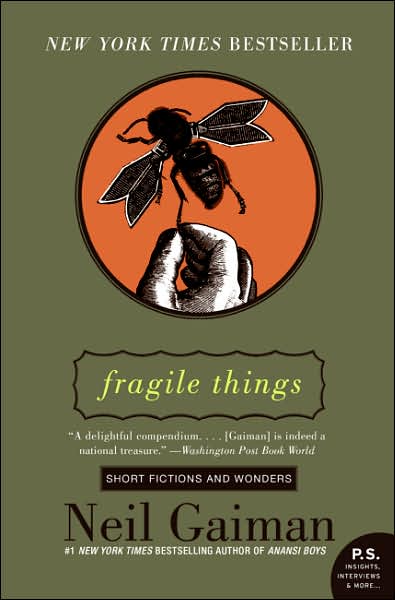
And we come back around to this Fragile Things cover, the beautiful one I get to enjoy during these two months. Though you can't tell from the image, the cover is actually vellum with the text and eggshell printed on it and the butterfly and snowflake are printed on the white book cover underneath. That's what gives them the faded appearance. They look different in real life than in this image -- less like pictures and more like actual specimens.

We're halfway through the group read and it's interesting to spend this much time thinking about a set of stories and poems. For days I thought about the comments on last week's post including those about Tori Amos and then, with fantastic timing, my iPod decided to play "Little Earthquakes" the other day when it hasn't "randomly" chosen Tori Amos in months. Carl was right -- her songs are still hauntingly beautiful and I think I will spend a little more time with her earlier albums this fall. And yet, maybe I'm spending a little too much time with Mr. Gaiman. Recently I had a dream that I woke up and Neil was waking up at the same time -- in my bed. There's wasn't anything going on, we had just, literally, become bedfellows. Anyway ...

(remember, there might be some SPOILERS ahead ...)

LOCKS

This is a beautiful little free-form piece about parenthood and story-telling that was written for Neil's daughter when she was two. You can read it here and there are plenty of videos out there of him reading it. It's about a father telling his two-year-old daughter the story of Goldilocks and also contemplating his own role as a Father Bear. He says in the introduction that stories are "the currency that we share with those who walked the world before ever we were here. (Telling stories to my children that I was, in my turn, told by my parents and grandparents makes me feel part of something special and odd, part of the continuous stream of life itself.)" I wasn't told many stories when I was a kid (although my dad would make up the most hilarious songs sometimes), but I know that my time reading with Z is a special time where we share a story. We may not experience it in exactly the same way or be looking to get the same things out of it, but the moment is there for us to remember, each in our own way.

THE PROBLEM OF SUSAN

I don't have any real connection to The Chronicles of Narnia. I read them when I was a kid (or most of them at least -- I can't really remember) and thought they were fine but I didn't love Narnia the way I loved Oz. So, I didn't recall what had happened to Susan and the others. But I do remember that Aslan and the White Witch never had dirty s.e.x. and Aslan never ate children. I have yet to be comfortable when Gaiman writes explicitly dirty things. It kind of ruins everything else around it for me because it rarely seems super relevant. I mean, Aslan could have still eaten Susan and Lucy without stopping for nookie in the middle, right? This story could have been okay (and was really thoughtful about the elderly Susan in parts) but really lost me toward the end there. I just searched for "gaiman susan" in the Googles and the second thing there after the Wikipedia entry on Susan Pevensie was the wonderful Jenny and her thoughts on this story from January 2009. You should go read what she says. It's smart and stuff and the comments go on for ages. It seems this story is thought-provoking for a lot of readers (who don't all have the same interpretations of it).

INSTRUCTIONS

Here is another free form poem that you can read online. It has the unique distinction of also having been turned into a picture book last year, illustrated by Charles Vess. Here is the book trailer that also includes the whole piece, read by Neil himself --


While I was embedding this, Z sat down and watched and listened with me. He seemed to like it quite a bit. This was strange because when I read it from my book just moments before, I thought it felt old and dark and my imagination took me to slightly frightening places that I didn't think were quite appropriate for children. But when Z was presented with these pictures along with the story, these ones with muted colors and only hints of danger, it was okay for him. And I think that's kind of the point of this piece. The instructions are for a journey through fantasy worlds -- whether it be the literal journey that Z still believes in (especially when he sees it right before his eyes) or the mental one that I took when I was reading. The instructions are a bit vague because the journey isn't the same for everyone. But the basic ways of getting through trials, both in fantasy and in life, are similar for most --

"Remember your name.
Do not lose hope--what you seek will be found.
...
Trust dreams.
Trust your heart, and trust your story."

HOW DO YOU THINK IT FEELS?

And then again with the s.e.x. I'm a bit perplexed by the order of the pieces this week. How can a poem, fit to be turned into a children's picture book, be nestled between two stories that are so incredibly adult? And this one isn't only very adult but it's very male. I got more and more annoyed as I read the story. Years later they meet up and she's still beautiful and trim but he's overweight and balding and she wants him more than ever? Of course. Although, I think this did finally clarify some of my thoughts on Gaiman and his writing of sex. At the start of the story, when the man and woman are young and in love, it's glossed over and barely mentioned, just a small part of all the things the couple does together and what their relationship is about. But later, it turns explicit when it's connected to sadness and anger and is the last remaining connection between them -- when it's no longer really love. Not my favorite story of the week (obviously) but I kind of get it.

Not thinking about how it feels,
K

Sunday, September 25, 2011

Fragile Things Group Read: Four Stories


This week just flew by and I totally was not able to do the story-a-day thing. Still, I wrote about each piece after reading it and that seems to have worked okay (except for a lack of good "absorbing" time).

Again, minor SPOILERS so be aware --

GOING WODWO

From the introduction: "A wodwo or wodwose, was a wild man of the woods." And while it's a very interesting word, I think the key word in the title of this short piece is "Going" because this is really a poem about the transition from a "regular" life to the escapism and communion of the wodwo lifestyle. The narrator talks about what he is leaving behind and the hardships of starting to live off the resources in the forest. At one point, you almost think he will give it up and head back but then he realizes that the spiritual gains outweigh the physical trials. This is a very thought-provoking piece and is an interesting addition to this collection -- though it certainly exposes a few "fragile things".

BITTER GROUNDS

There was nothing wrong with this story. But I don't like Santeria or zombies and so I didn't really like this either. It was well written but it wasn't for me. It just made me sad and uncomfortable. It's strange because I like fantasy magic A LOT but this particular flavor of New Orleans magic, the kind that is always associated with evil and never with good, just seems pointlessly dark to me -- kind of like the bitter grounds left after brewing strong, black coffee.

OTHER PEOPLE

The most puzzling thing about this story is the title. Interestingly (and according to the introduction), it wasn't Gaiman's title for the piece. He called it "Afterlife", which makes much more sense to me. This is a brilliant little story that truly proves a well-known quote --
"We are each our own devil, and we make this world our hell." -- Oscar Wilde
KEEPSAKES AND TREASURES

This was one story that I wanted to re-read again now that I've finally read American Gods because it's supposedly set in the same world. It turned out to be incredibly disturbing and revolting. I didn't remember much about it as I was re-reading it, which means I probably put it out of my mind, trying to not absorb any of its darkness. Though there were many dark and violent things in American Gods, there was nothing quite like this and for that I'm glad. I'm wondering if there will be anyone in the reading group that truly likes this story.

Hoping for something bright and beautiful next week,
K

Sunday, September 11, 2011

Fragile Things Group Read: Introduction and Three Fragile Things


I'm very excited to begin my second reading of Neil Gaiman's short story collection Fragile Things: Short Fictions and Wonders with this RIP Challenge group read.

From Carl of Stainless Steel Droppings:
There are 32 short stories in Fragile Things, counting the introduction. Those of you who have read a Neil Gaiman short story collection know that it is a special treat to read the introduction. Not counting Sunday, September 4th (because that is almost upon us), there are 8 Sundays during the R.I.P. Challenge (Sept 1 through Oct 31st). The plan will be to read 4 stories per week and post about them on each Sunday throughout the challenge. The Fragile Things reading will officially begin on September 1st and this first week will include the:
Introduction, A Study in Emerald, The Fairy Reel and October in the Chair.
We will post about these stories on Sunday, September 11th.
My goal is to read only one story a day and write about it that same day so that I can really give a good amount of thought to each piece (we'll see if that happens!). This was the first of Neil's writings that I read in October 2008 (brief thoughts) and I'm guessing that, now that I know him and his style better, I will have different views on some of the pieces (although I will probably love many of the same ones!).

I placed my hold again at the library but then thought that, since this is a second reading, I would just try to find a good copy of the book to own. I was very lucky to find a used hardcover with the beautiful cover above that looks as if it has never been read! So, without further ado, let's start with --

INTRODUCTION

In about 20 pages, Neil Gaiman visits the circumstances behind all of the pieces in the book -- whether they were written for anthologies or gifts, in a brief flash of inspiration or after years of aging in a box in the attic. There's even a short story within the introduction that couldn't find a home elsewhere. What I've found most interesting about Gaiman over the past few years of reading his blog is that he is able to relate the smallest things in life in a way that makes it all seem magical. I think that it's because he believes in the magic of everyday life. You may be doing something mundane or run-of-the-mill but that doesn't change the fact that you are the only person doing it at that moment, in that place, in just that way. I think this is one of the "fragile things" that Gaiman tries to define in the introduction to this collection.
"I believe we owe it to each other to tell stories. It's as close to a credo as I have or will, I suspect, ever get."
"Stories, like people and butterflies and songbirds' eggs and human hearts and dreams, are also fragile things, made up of nothing stronger or more lasting than twenty-six letters and a handful of punctuation marks. Or they are words on the air, composed of sounds and ideas--abstract, invisible, gone once they've been spoken--and what could be more frail than that? But some stories, small, simple ones about setting out on adventures or people doing wonders, tales of miracles and monsters, have outlasted all the people who told them, and some of them have outlasted the lands in which they were created."
A STUDY IN EMERALD

As a marriage of Sherlock Holmes and H.P. Lovecraft, this story is pretty straight-forward. There are beasts in caves and the world has been ruled by tentacled monsters for seven hundred years. And, of course, there are mysteries to be solved and Sherlock Holmes is still on the case. And this story proceeds in a fairly predictable manner -- until right before the end when something rather shocking is revealed and it elevates the story to a whole new level. I remember feeling this same way the first time I read the story but somehow had forgotten the twist. I find that the "fragile things" in this story are one's assumptions.

THE FAIRY REEL

This is a poem of regret at a foolish choice made as a youth. It's simple and sad but also a bit sterile somehow. I'm hoping that other readers have something more to say about it.

OCTOBER IN THE CHAIR

This story is quintessential Gaiman. The voice, the topic -- it's exactly what you get in novels like American Gods and The Graveyard Book. In fact, this story was born of the same idea for The Graveyard Book and it shows. It's an archetypal sort of story but at the same time it seems entirely unique. He personifies the Months in such a way that you can actually see them sitting, together in a wood around a campfire, telling stories and bickering. In fact, I went searching to see if the story happened to exist online and came across these illustrations (by artist Mike Sgier) of April and June and these of May and October (from the Tumblr called Pochemuchka) and they are just as I imagined them -- showing that Gaiman's storytelling is so vivid that most readers will actually see these characters the same way in their minds. And the part of the story about a young boy who feels unloved and runs away from home is heartbreaking. I can't recommend this story enough if you want a small taste of Neil Gaiman's work.

I'm already glad that I decided to participate in this group read. I'm experiencing these stories in a different way than I did the first time, especially October in the Chair which I could barely remember but now wanted to read again immediately. This is going to be a wonderful journey.

Until next week,
K

Thursday, April 14, 2011

New Paperback Release: Russian Winter

A beautiful and engaging novel, Russian Winter by Daphne Kalotay will sweep you up in the tragedies of life in Soviet Russia and have you hoping and praying for present-day redemption. There are many narratives in this novel including those of the young Nina Revskaya, ballerina at the Bolshoi and also her ailing modern self, now residing in Boston. There is also Grigoiri Solodin, a professor who was adopted as a newborn in Russia and who believes he has traced his parentage to Nina through the few small artifacts he inherited. And finally there is Drew Brooks, a woman who works at the auction house where Nina Revskaya is selling her famous jewelry collection. Though the lives of these people seem to have little in common, we see that there are common human threads that run through each of their lives.

I'll admit to having lost track of time and I started this book a bit late but it wasn't a chore at all to read this almost-500-page book over the course of three days. I got caught up in Nina's story and couldn't wait to find out what had happened to cause her defection from the Soviet Union and to learn if Grigori was really her son. Some readers might be a bit put off at first by the switching of tenses in the novel (the past story is written in the present tense) but after a while it simply becomes the natural rhythm of the book. There were a few slightly redundant parts and it took me some time to care about Grigori and Drew's stories but it all came together nicely by the end. As for Nina, I fell in love with her, as did so many others, and her story slowly broke my heart.

As I was reading this novel, I realized that though I frequently read novels set in Russia, they are never set in this time period of Stalin and Communism. I enjoyed this journey and appreciated the depth of Kalotay's research. The artforms that she chose to include in the story--ballet, music and poetry--are all well-incorporated as well and make this an epic sort of novel.

Coveting the jewels,
K


This novel is currently on a TLC Book Tour. You can read other reviews at the following sites:

Library Queue
Luxury Reading
nomadreader
A Few More Pages

Other reviews will be linked up at the tour page during the coming month.

Support our site and buy Russian Winter on Amazon or find it at your local library. We received a finished copy for review.

Thursday, April 29, 2010

Poem in Your Pocket Day and Poetry Month Wrap-Up

Happy Poem in Your Pocket Day!  From poets.org ...
The idea is simple: select a poem you love during National Poetry Month then carry it with you to share with co-workers, family, and friends on April 29, 2010.

Poems from pockets will be unfolded throughout the day with events in parks, libraries, schools, workplaces, and bookstores.
Z and I have chosen our poems this year from Shel Silverstein's classic Where the Sidewalk Ends.  I wanted Z to choose Hug O' War but he chose ...
Homemade Boat
This boat that we just built is just fine--
And don't try to tell us it's not.
The sides and the back are divine--
It's the bottom I guess we forgot.

I chose a Silverstein classic --
Listen To The Mustn'ts
Listen to the MUSTN'TS child,
Listen to the DON'TS
Listen to the SHOULDN'TS
The IMPOSSIBLES, the WON'TS
Listen to the NEVER HAVES
Then listen close to me--
Anything can happen, child.
ANYTHING can be.
We hope you enjoyed our kid poetry focus this month.  We loved reading a load of nonsense, going through the Big Book, and learning about different forms of poetry.  Z and I talked together about the different subjects poems can be about -- nature, family, school and so much more.  I think it's much more likely that he will find poetry approachable later in life if we incorporate it into his reading now.  Tonight he was chuckling at the humor of Shel Silverstein and we've agreed not to leave this book on the shelf for a whole 'nother year!

Reading rhymes is really fun --
Exploring poems -- we are done,
K and Z

Wednesday, April 21, 2010

Nonsense Words Make Lasting Poetry

I struggled with writing this post about two of our favorite poets that happen to have something in common -- they are both Victorians and they both made sense out of nonsense.  You see, it kept coming out all stodgy and boring and these poets are anything but.  So let's just get to the poetry and these creators of the fantastic!

Edward Lear (1812-1888) traveled extensively through India, Greece and Egypt, suffered from epilepsy and had almost no formal education.  He was a master of the limerick and the nonsense poem.  He was also a very accomplished artist.


The Owl and The Pussy-cat

The Owl and the Pussy-cat went to sea
In a beautiful pea-green boat,
They took some honey, and plenty of money,
Wrapped up in a five-pound note.
The Owl looked up to the stars above,
And sang to a small guitar,
"O lovely Pussy! O Pussy my love,
What a beautiful Pussy you are,
You are,
You are!
What a beautiful Pussy you are!"

Pussy said to the Owl, "You elegant fowl!
How charmingly sweet you sing!
O let us be married! too long we have tarried:
But what shall we do for a ring?"
They sailed away, for a year and a day,
To the land where the Bong-tree grows
And there in a wood a Piggy-wig stood
With a ring at the end of his nose,
His nose,
His nose,
With a ring at the end of his nose.

"Dear Pig, are you willing to sell for one shilling
Your ring?" Said the Piggy, "I will."
So they took it away, and were married next day
By the turkey who lives on the hill.
They dined on mince, and slices of quince,
Which they ate with a runcible spoon;
And hand in hand on the edge of the sand,
They danced by the light of the moon,
The moon,
The moon,
They danced by the light of the moon.

Lewis Carroll (a.k.a. Charles Dodgson, 1832-1898) stayed at home in England, was deaf in one ear, had a stammer and a "weak chest" and spent years teaching mathematics at Oxford.


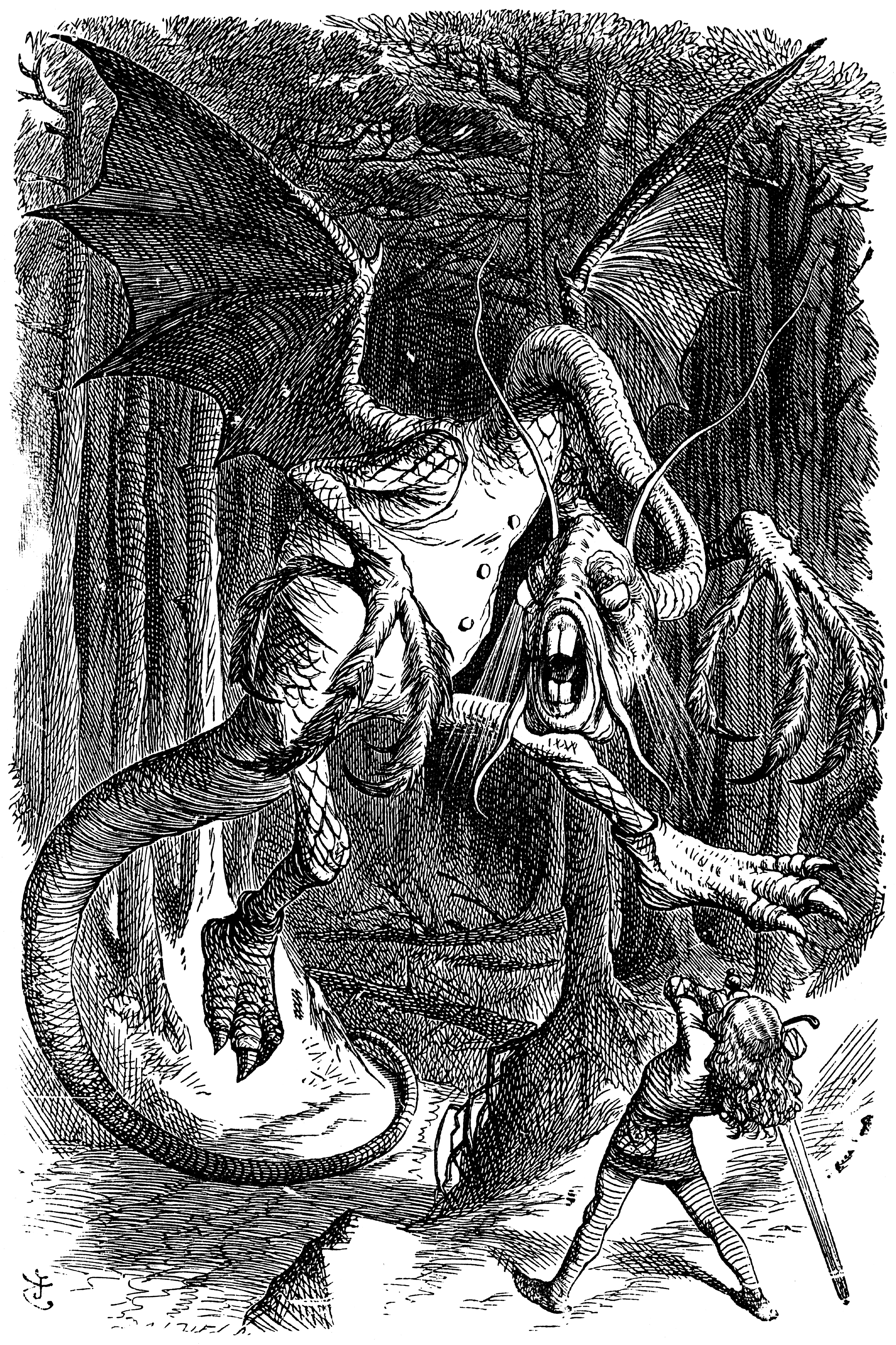
Jabberwocky
'Twas brillig, and the slithy toves
Did gyre and gimble in the wabe;
All mimsy were the borogoves,
And the mome raths outgrabe.

"Beware the Jabberwock, my son!
The jaws that bite, the claws that catch!
Beware the Jubjub bird, and shun
The frumious Bandersnatch!"

He took his vorpal sword in hand:
Long time the manxome foe he sought--
So rested he by the Tumtum tree,
And stood awhile in thought.

And as in uffish thought he stood,
The Jabberwock, with eyes of flame,
Came whiffling through the tulgey wood,
And burbled as it came!

One, two! One, two! And through and through
The vorpal blade went snicker-snack!
He left it dead, and with its head
He went galumphing back.

"And hast thou slain the Jabberwock?
Come to my arms, my beamish boy!
O frabjous day! Callooh! Callay!"
He chortled in his joy.

'Twas brillig, and the slithy toves
Did gyre and gimble in the wabe;
All mimsy were the borogoves,
And the mome raths outgrabe.

So what do you think?  Do these poems have a chance in the modern age?  Some of the words have different meanings now (that luckily Z is too young to know) and some of them still have no meaning but does anything sound better than a "frabjous day"?


Reveling in the nonsense,
K and Z

Tuesday, April 13, 2010

A Poetry Anthology for All Children

When I was working the book fair at Z's school last year, I noticed The Bill Martin Jr. Big Book of Poetry.  I didn't get a chance to look at it so I grabbed a copy from the library this month for our poetry project.  This is a beautiful book that was printed as a tribute to Bill Martin Jr. who passed away in 2004.  I'm sure you know Martin from his books Brown Bear, Brown Bear, What Do You See? and Chicka Chicka Boom Boom.  This book has 200 poems, selected by Martin and his friend and collaborator Michael Sampson.  It also has the work of 13 well-known artists like Lois Ehlert and Dan Yaccarino.

There are poems for all tastes in this anthology -- divided into categories like animals, nature, places, school and family.  The poets represented are numerous and most of the poems here were new to me.  Some are short and sweet and others are a bit longer but there is nothing that would try the attention span of even the youngest listeners.  This book is bright and beautiful and really succeeds is making poetry accessible.

We want to share two poems from the book -- one was Z's favorite and one was mine.  See if you can guess which is which.

Crocodile
by Anonymous

If you should meet a crocodile
Don't take a stick and poke him;
Ignore the welcome in his smile,
Be careful not to stroke him.
For as he sleeps upon the Nile,
He thinner gets and thinner;
Whenever you meet a crocodile
He's looking for his dinner.

My Shadow
by Robert Louis Stevenson

I have a little shadow that goes in and out with me,
And what can be the use of him is more than I can see.
He is very, very like me from the heels up to the head;
And I see him jump before me, when I jump into my bed.

The funniest thing about him is the way he likes to grow--
Not at all like proper children, which is always very slow;
For he sometimes shoots up taller like an india-rubber ball,
And he sometimes goes so little that there's none of him at all.

He hasn't got a notion of how children ought to play,
And can only make a fool of me in every sort of way.
He stays so close behind me, he's a coward you can see;
I'd think shame to stick to nursie as that shadow sticks to me!

One morning, very early, before the sun was up,
I rose and found the shining dew on every buttercup;
But my lazy little shadow, like an arrant sleepy-head,
Had stayed at home behind me and was fast asleep in bed.
Enjoying the varied world of poetry,
K and Z


Support our site and buy The Bill Martin Jr Big Book of Poetry on Amazon or find it at your local library. We borrowed our copy from the library.

Tuesday, April 6, 2010

Two Modern Poetry Picture Books

What originally gave me the idea to focus on children's poetry this month was an email from a Candlewick Press publicist asking if I would like to review any of their current poetry books.  Z happens to have an interest in poetry so I accepted two books that I thought would be a good fit for us.

The first is Messing Around on the Monkey Bars by Betsy Franco and illustrated by Jessie Hartland.  This is a book of poems about school that are read in two voices.  The text is different levels of bold for each reader.  There are poems about lunch, recess, the school bus, homework and much more.  This is a book that requires the participants to be readers rather than just listeners.

The subject matter in some of these turned out to be just a bit old for Z.  Since he's only in half-day Kindergarten, he doesn't ride the bus or have lunch.  He also doesn't have some of the subjects mentioned in the poems.  Still, he liked the interactiveness of the poems and there were a few that worked for him -- like New Kid at School, In the Library, and Me and Joe Lining Up After Recess -- a fun one about two kids who are chatty and fidgety in line!  This book should do really well with most grade school kids.  The back of the book also has alternate ideas for reading the poems with larger groups of kids -- something that made me want to bring this book to the attention of our school librarian!

The second book we received is African Acrostics with poems by Avis Harley and photographs by Deborah Noyes.  (And if you recognize the name ... yes, it's that Deborah Noyes.  Strangely, I will be reading her novel Captivity in the next month or two).

If you aren't sure what an acrostic is, the book starts with a great poem about acrostics!
Explore the acrostic that rides
Down the page.
Get a word you
Enjoy and would like to define.
Write it down vertically
And fill in each line.
Your name is a very good way to begin.
Surprise yourself.  Find that poem within!

Z absolutely loved this book.  He loves puzzles and word play and these acrostics with their hidden messages got him very excited.  He's also always loved African animals and this book has fantastic photographs and animal facts.  A couple of the poems are a bit awkward due to the forced nature of an acrostic.  Most of them, though, are quite witty and fun.  Z kept looking at this book through the rest of the afternoon after we read it together.

I think one thing that turns some children off to poetry are the traditional style books with dull watercolors and pencil sketches and I think both of these books do a great job of bringing poetry to modern children.  The books are visually appealing and the subject matter is something easily understandable by most kids.

Reading together in verse,
K and Z


Support our site and buy Messing Around on the Monkey Bars: and Other School Poems for Two Voices and African Acrostics: A Word in Edgeways on Amazon or find them at your local library. We received our copies from the publisher.

Friday, April 2, 2010

April is National Poetry Month


Welcome to National Poetry Month!  I have decided to focus on reading children's poetry this month with Z and we invite you to join us on your own blog or here in comments.  If you read a children's poem or book of poetry, stop by and tell us about it or leave a link on any of our poetry-related posts!

My favorite poetry related day is Poem In Your Pocket Day.  Don't forget on Thursday April 29 to write down a poem and put it in your pocket -- ready for the right moment to share it with a friend or family member.  I am going to put one in Z's pocket to share at school!  We'll share our poems with you on that day too.

If you need some ideas for the month, some of the books we will be pulling off of our shelves or getting from the library are --
Where the Sidewalk Ends by Shel Silverstein
The Original Mother Goose
The Bill Martin Jr. Big Book of Poetry by Bill Martin Jr.
Messing Around on the Monkey Bars by Betsy Franco (courtesy of Candlewick Press)
African Acrostics: A Word In Edgeways by Deborah Noyes (also courtesy of Candlewick Press)
Poetry for Young People by Edward Lear
William Carlos Williams: Poetry for Young People by William Carlos Williams
Sea Watch: A Book of Poetry by Jane Yolen
In the Eyes of the Cat: Japanese Poetry for All Seasons selected by Demi
Be Glad Your Nose is On Your Face and Other Poems by Jack Prelutsky
and, of course, a bit of Dr. Seuss!

I also just found an amazing site, The Children's Poetry Archive, where you can hear poets reading their own works!  It's amazing to hear Langston Hughes reading "I, Too", recorded in 1955.

Signing off
but not in verse --
My prose is bad,
my poetry worse,
K and Z

Friday, November 20, 2009

Poe Fridays: The Bells

Today's Poe Fridays poem is The Bells. You can read it here. I've copied the beginning of each part of it to represent the change of mood but you should definitely read the entire poem.

Hear the sledges with the bells -
Silver bells!
What a world of merriment their melody foretells!
How they tinkle, tinkle, tinkle,
In the icy air of night!
While the stars that oversprinkle
All the heavens seem to twinkle
With a crystalline delight;
...
Hear the mellow wedding bells -
Golden bells!
What a world of happiness their harmony foretells!
Through the balmy air of night
How they ring out their delight!
From the molten-golden notes,
And all in tune,
What a liquid ditty floats
To the turtle-dove that listens, while she gloats
On the moon!
...
Hear the loud alarum bells -
Brazen bells!
What a tale of terror, now, their turbulency tells!
In the startled ear of night
How they scream out their affright!
Too much horrified to speak,
They can only shriek, shriek,
Out of tune,
In a clamorous appealing to the mercy of the fire,
In a mad expostulation with the deaf and frantic fire,
...
Hear the tolling of the bells -
Iron bells!
What a world of solemn thought their monody compels!
In the silence of the night,
How we shiver with affright
At the melancholy menace of their tone!
For every sound that floats
From the rust within their throats
Is a groan.

This poem was first published after Poe's death. It is a very thoughtful movement from birth to death and also an example of the many faces of a single symbol. This poem highlights the fact that we have different words for the same sounds based on the emotions of the moment -- bells "peal" when we are happy, "clang" when we are anxious and "toll" when they are rung in mourning. This is another of Poe's works that really comes to life when read out loud. There is musicality in the words and the rhythm that enhances the idea of the bells. This is one of my favorite Poe poems.

Because next week is Thanksgiving and I have family coming to visit, I'm going to take a break from Poe Fridays until the following week. The longish short story for December 4th will be The Purloined Letter -- another story featuring Poe's French detective, C. Auguste Dupin.

Still enjoying the bells of youth,
K

Friday, October 30, 2009

Poe Fridays: The Raven

This week's fantastic Poe Fridays poem is The Raven. If you haven't read it before, you can find it here. But even if you have read it, why not go back for a re-read ... I'll wait.

This is not only the most recognized Poe poem but I would venture that it is one of the most well-constructed poems of all time. The cadence is perfect, the word choice is inspired and the mounting tension throughout the poem provides for the perfect read-aloud experience.

Once upon a midnight dreary, while I pondered, weak and weary,
Over many a quaint and curious volume of forgotten lore,
While I nodded, nearly napping, suddenly there came a tapping,
As of some one gently rapping, rapping at my chamber door.
"'Tis some visitor," I muttered, "tapping at my chamber door-
Only this, and nothing more."

Ah, distinctly I remember it was in the bleak December,
And each separate dying ember wrought its ghost upon the floor.
Eagerly I wished the morrow;- vainly I had sought to borrow
From my books surcease of sorrow- sorrow for the lost Lenore-
For the rare and radiant maiden whom the angels name Lenore-
Nameless here for evermore.

And the silken, sad, uncertain rustling of each purple curtain
Thrilled me- filled me with fantastic terrors never felt before;
So that now, to still the beating of my heart, I stood repeating,
"'Tis some visitor entreating entrance at my chamber door-
Some late visitor entreating entrance at my chamber door;-
This it is, and nothing more."


I'm not sure I've revealed this little tidbit about myself yet but I adore Vincent Price. I love him in his classic horror films and also in his dramatic roles (like my favorite film noir, Laura). And as the most fabulous thing about him is his voice, I leave you on this Halloween Eve with his reading of The Raven.


And for J.T. -- I found the Simpsons version!

For next week's Poe Fridays, let's read the short story William Wilson.

Nevermore,
K

Friday, October 16, 2009

Poe Fridays: Ulalume

This week's Poe Fridays poem was the October-themed Ulalume. You can read it here. My apologies for the link included last week that seems to have been missing a few of the stanzas.

I'll share the first three stanzas with you as Poe employs a very unusual technique of word repetition in this poem.
The skies they were ashen and sober;
The leaves they were crisped and sere--
The leaves they were withering and sere;
It was night in the lonesome October
Of my most immemorial year:
It was hard by the dim lake of Auber,
In the misty mid region of Weir--
It was down by the dank tarn of Auber,
In the ghoul-haunted woodland of Weir.

Here once, through an alley Titanic,
Of cypress, I roamed with my Soul--
Of cypress, with Psyche, my Soul.
These were days when my heart was volcanic
As the scoriac rivers that roll--
As the lavas that restlessly roll
Their sulphurous currents down Yaanek
In the ultimate climes of the pole--
That groan as they roll down Mount Yaanek
In the realms of the boreal pole.

Our talk had been serious and sober,
But our thoughts they were palsied and sere--
Our memories were treacherous and sere,--
For we knew not the month was October,
And we marked not the night of the year
(Ah, night of all nights in the year!)--
We noted not the dim lake of Auber
(Though once we had journeyed down here)--
Remembered not the dank tarn of Auber,
Nor the ghoul-haunted woodland of Weir.

The first thing I had to do when I finished this poem for the first time was to find out the meanings of some of the words. Ulalume? It's a name. Sere means "dried-up". Scoriac refers to scoria - a type of volcanic rock similar to pumice but more cindery. Mount Yaanek is Mount Erebus, a volcano in Antarctica.

After clearing up some of the vocabulary, I appreciated this poem much more. It's actually a rather simple one that again explores one of Poe's preferred topics -- a dead lover. The narrator goes for a walk on a crisp October night, not realizing that his steps will take him to the burial chamber of his lost love, Ulalume, whom he buried a year ago on that day. His grief is still fresh and is exacerbated by this unconscious return to the crypt. As with all of Poe's poetry about loss, many different theories abound as to whether this poem was inspired by the death of Virginia or perhaps a more general musing about the many losses of women in his life. Whatever the influence, this is a touching poem and a great read for a cold October evening.

For next week I chose a horror classic, the short story The Pit and the Pendulum. I'm really excited to re-read this one.

Writing this on a crisp, October morn -- enjoying this on a brisk October morn,
K

Thursday, October 15, 2009

New Release: The Age of Wonder

Though I've been busy with my seasonal reads, I took the time out to read a non-fiction title that proved almost as exciting as any of the sensational stories. Hiding behind the impressive title of The Age of Wonder: How the Romantic Generation Discovered the Beauty and Terror of Science, Richard Holmes has written a highly accessible book about the progress of science in England during the Georgian and Regency times.

This book is more than a simple timeline of historical events related to science and natural philosophy. It is a string of biographies and also a period history including the politics, poetry and religion of the times. Holmes is a fantastic writer with a sense of humor and an easy way of presenting what could be a daunting subject. Whether discussing William Herschel and his expansion of our knowledge of the cosmos, Joseph Banks and his exploration and leadership skills or Humphry Davy and his chemistry and engineering genius, each man comes alive and his contribution to science during the Romantic Era is clear. And if you have no interest in these pioneers then perhaps you will enjoy reading about Mary Shelley and the effect of her well-known novel on the public view of science or about the poets Keats, Shelley and Coleridge and their support of and inclusion of science in their poetry and prose. I enjoyed seeing how the groundwork was laid for such geniuses as Darwin and Faraday -- the establishment of a climate in England that allowed these men (and a few women) to revolutionize our theories and our world during Victorian times.

I strongly recommend this book to anyone with an interest in history, science or Georgian and Regency England.

Appreciating when fact proves as compelling as fiction,
K


Support our site and buy The Age of Wonder: How the Romantic Generation Discovered the Beauty and Terror of Science on Amazon or find it at your local library. We asked the publisher for our copy.

Wednesday, October 14, 2009

Monster Poems That Frighten and Inform

Are you looking to frighten a child in your life? Not sure where to start? How about trying out the gamut of monsters and seeing what scares them the most? ::wink::

The Monsterologist: A Memoir in Rhyme is a book that came out this spring and introduces children (and their uninformed parents) to some common monsters that one may find in film, literature and everyday life. "Ghostwritten" by Bobbi Katz and illustrated by Adam McCauley, this is a somewhat tame outing that can be appreciated by most kids over the age of five or six. There isn't anything terribly scary in it and in fact most of the humor seems to be for the parents who get to read this out loud (like the Zombie census form). Being a classic monster fan, I loved introducing Z to some of my favorites like King Kong, the Loch Ness Monster, Kraken, Yeti and Doctor Frankenstein.

I found the illustrations in this book to be more consistently awesome than the writing. I loved some of the poems but others focused too much on rhyme and not enough on rhythm or content. Z shouted out "this is a rhyming poem!" during a couple of them because the rhymes were so heavy-handed and obvious. The author also didn't seem to "get" what makes some of these monsters so cool -- like turning King Kong into a Ping Pong opponent, having Godzilla be a fan of milkshakes (?) and revealing that the Yeti eats spaghetti. These just seemed a bit too cheesy and I was hoping for something a little more in the spirit of these scary classic monsters.


Still, many of the entries were totally amusing. There is a witchy version of the song "My Favorite Things" that is really clever. You will also not want to miss the recipe for Grendel's "Danish Pastry" -- full of lots of tasty Danes. The best poem is probably the one titled "From the desk of Count Dracula" and is an invitation to visit him in Transylvania.
Just buy a one-way ticket. There's no need to splurge.
I'd really love to see you. It's an overwhelming urge.
You'll find that I'm a genial host,
but at times I think I'll burst,
unless I drink a bit of blood to satisfy my thirst.
A friendly nip, a little sip is harmless, you'll agree.
It's natural and organic, and my castle is smoke-free."

My favorite part of the book though was teaching Z the song "The Worms Crawl In". He's been singing it for days and it cracks me up.

Head over to Adam McCauley's website to see his award-winning endpaper design for the book -- faux stamps based on classic movie monsters. They're fantastic!

I'm having a great time sharing some scary reads with Z this year. He's finally old enough for some gentle frights and I love seeing some of these things through fresh eyes -- like the fact that he thinks the Kraken is female (he calls her "Mrs. Kraken"). And I certainly never thought I would have the chance to explain The Golem to a five year old but suddenly "a man made of mud" sounds much cooler. Z's eyes lit up at that idea!

Monster poems are really great ... don't put them off 'til it's too late!
K and Z


Support our site and buy The Monsterologist: A Memoir in Rhyme on Amazon or find it at your local library. We borrowed this book from the library.

Friday, October 2, 2009

Poe Fridays: The Haunted Palace

Here we are again at Poe Friday and for this week I chose the poem The Haunted Palace. You can read it here. This is an excerpt --
And all with pearl and ruby glowing
Was the fair palace door,
Through which came flowing, flowing, flowing,
And sparkling evermore,
A troop of Echoes, whose sweet duty
Was but to sing,
In voices of surpassing beauty,
The wit and wisdom of their king.

But evil things, in robes of sorrow,
Assailed the monarch's high estate.
(Ah, let us mourn!- for never morrow
Shall dawn upon him desolate!)
And round about his home the glory
That blushed and bloomed,
Is but a dim-remembered story
Of the old time entombed.

This poem was incorporated into the story The Fall of the House of Usher but it was previously published on its own. It's not in fact about a palace of stone but the palace of the mind. It's a happy, healthy place for a time but then "evil things" come and bring about the downfall of the "palace". This is quite a depressing poem, especially since there's not much discussion of what the malady was that brought down the mind of the man. This poem honestly just makes me feel sad.

For next week I've chosen the short story Some Words With a Mummy. I'm hoping it's scary but knowing Poe, it might be philosophical instead.

Spending time cleaning and polishing in the palace,
K