Showing posts with label ballads. Show all posts
Friday, April 27, 2012
Fire and Hemlock Read-Along Discussion
I'm so excited to have a chance to trade ideas about Fire and Hemlock with some other readers! It's a complex and somewhat confusingly-ended book that is completely awesome. For those of you who haven't read the book and intend to, this post isn't for you. Spoilers will be plentiful. Instead, go get a copy of the book, devour it quickly and then come back and discuss it with us! If you haven't decided if you want to read the book yet (you do) or if you haven't heard of it (really?), here's a brief synopsis --
Nineteen year old Polly is cleaning out her room, about to head back to Oxford, and is reading an old book of hers when she starts thinking that years ago, when she first read the same collection, it possibly had a different title, different authors and even different stories in it. Slowly, that feeling spreads as she notices more things in her room that seem out of place in her current memories until she starts recovering an entirely different set of memories from when she was ten years old. How could she have forgotten Thomas Lynn, the cellist that she met when she gate-crashed a funeral on Halloween? How did the eerie photograph titled Fire and Hemlock that is hanging over her bed get there? And more importantly, what happened four years ago that made her forget all of it?
Doesn't that sound awesome? Well, it is. So, get out, buy the newly re-released book and get to reading. For those who have read it, let's discuss!
Here are some recent(ish) posts from Iris, Teresa, Jenny, Kerry, Amanda, Jean ... (more will be added)
* * * * *
I know we will all have different things that stood out or that didn't make sense for us so here are a few of mine. Feel free to answer all or none of my questions and add more of your own below.
First, I read many versions of both Tam Lin and Thomas the Rhymer in preparation for this reread. It definitely enhanced the experience of reading this time through when I could actually catch a tidbit and know why it was there. Have you read either ballad or a related story? Is F&H a retelling of Tam Lin or is it far too original to be called that? Side question: Did it bother you that the quotes at the beginnings of each chapter from the ballads didn't really match up with what is happening in the story at the time? I kind of feel now like those could have been left out.
Second, what was the deal with the necklace? It was protection (how?) and then it wasn't. How do they start using it against her? Is it a tracking device?
Third, was Thomas musically gifted before Laurel or did she give him that talent? I know that the horse couldn't help him at the end because it wasn't "truly his" -- it came from the gift of having things come true. But why didn't the cello work? Did he become a world class player because he believed he would?
I think that's a good start. Those are the things that I thought about for more than a few minutes anyway -- well, besides the confusing anywhere/nowhere/somewhere word play at the end -- but I don't even know how to put together a coherent question about that!
And we're off,
K
Monday, April 23, 2012
Thomas the Rhymer: A Survey
As in my Tam Lin post last week, I was able to read a couple of sources to become more familiar with the story of Thomas the Rhymer. Here is a link to the Child version of this ballad.
Unlike Tam Lin who was taken against his will for many years and then rescued from the Fairy Queen right before he was to be sacrificed to Hell, Thomas the Rhymer, an adventurous minstrel/harper by trade, goes willingly with the queen after meeting her on the Eildon Hills and getting a kiss from her. She takes him to Elfland for seven years during which time he is unable to speak, bound only to be an observer and the Queen's lover. At the end of seven years, he is released and he is given the gift of true speech.
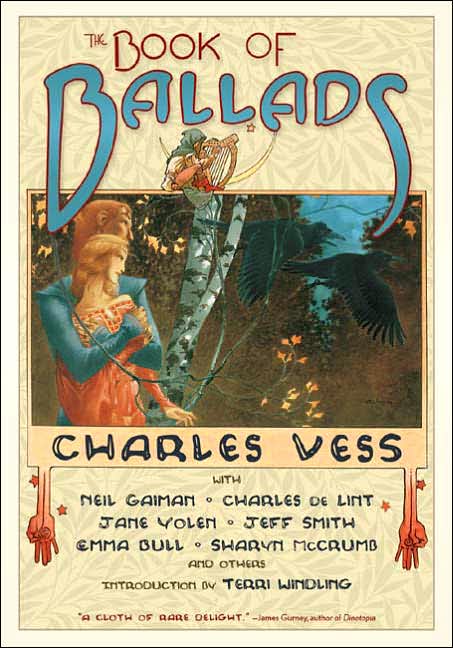
I read a brief version in Barbara Ker Wilson's Stories from Scotland and then the illustrated version in The Book of Ballads (text by Sharyn McCrumb, illustrations by Charles Vess). I don't think my library system had any picture book version of the story but it makes sense because this is basically the story of a human who sees the beautiful fairy queen and decides that it's worth seven years of his life to be her lover.
After I read both of those, I read Ellen Kushner's novel Thomas the Rhymer. To be honest, this book is more of what I thought Tam Lin would be -- taking the original ballad and making a full story out of it. I really loved reading this one! It is told from four different points of view, one being Thomas' during his time in Elfland. It has a romance added in but I didn't think that took away from the original ballad at all. This was such a bittersweet story and the reader is obviously meant to fall for Thomas. And that's where this story differs so much from Tam Lin -- because Tam Lin is obviously about the strong and independent Janet, despite the title, but Thomas is about a man who can take care of himself.
I can't wait to discuss these two ballads in the context of Fire and Hemlock on Friday!
Under the spell,
K
Unlike Tam Lin who was taken against his will for many years and then rescued from the Fairy Queen right before he was to be sacrificed to Hell, Thomas the Rhymer, an adventurous minstrel/harper by trade, goes willingly with the queen after meeting her on the Eildon Hills and getting a kiss from her. She takes him to Elfland for seven years during which time he is unable to speak, bound only to be an observer and the Queen's lover. At the end of seven years, he is released and he is given the gift of true speech.
Syne they came on to a garden green,It appears the ballad is not always continued past the point where he returns to the world of man but, when it is, it turns out that his "true speech" is the power of prophecy. He uses this power across the land and lives a comfortable life until the Fairy Queen sends two messengers--two white deer--to fetch him back to her for good and even this time he goes willingly.
And she pu'd an apple frae the tree:
"Take this for thy wages, True Thomas,
It will give the tongue that can never lie."
I read a brief version in Barbara Ker Wilson's Stories from Scotland and then the illustrated version in The Book of Ballads (text by Sharyn McCrumb, illustrations by Charles Vess). I don't think my library system had any picture book version of the story but it makes sense because this is basically the story of a human who sees the beautiful fairy queen and decides that it's worth seven years of his life to be her lover.
After I read both of those, I read Ellen Kushner's novel Thomas the Rhymer. To be honest, this book is more of what I thought Tam Lin would be -- taking the original ballad and making a full story out of it. I really loved reading this one! It is told from four different points of view, one being Thomas' during his time in Elfland. It has a romance added in but I didn't think that took away from the original ballad at all. This was such a bittersweet story and the reader is obviously meant to fall for Thomas. And that's where this story differs so much from Tam Lin -- because Tam Lin is obviously about the strong and independent Janet, despite the title, but Thomas is about a man who can take care of himself.
I can't wait to discuss these two ballads in the context of Fire and Hemlock on Friday!
Under the spell,
K
Thursday, April 19, 2012
Tam Lin: A Survey
The Fire and Hemlock Read-Along discussion is at the end of next week but I thought I would write about the Tam Lin readings I've done in preparation. Then I can just discuss the tale in the context of F&H next week. I ended up reading five retellings and the original Scottish ballad and none of them were identical.If you aren't familiar with the ballad, here is a great place where you can read Tam Lin (Child 39A version) and it has translations for the Scottish words on the side (very helpful!). The basic story is that a Scottish lass named Janet (or Jennet or Margaret) is warned away from a place called Carterhaugh --
O I forbid you, maidens all,That wear gold in your hair,To come or go by Carterhaugh,For young Tam Lin is there.
She goes anyway because her father owns the land where this shadowy glen is and there she picks a rose, which summons Tam Lin (or Tamlane or Tam-a-Lin). He was once a man but then he was captured by the fairies and has lived with them for a very long time. However, they have a custom that, every seven years, they make a human sacrifice to Hell to preserve their way of life and he is the chosen one this time. It also happens though that Janet falls instantly in love with him and becomes pregnant with his child. She returns home and is shamed but defiant and so she returns to Carterhaugh. Then Tam Lin tells her that there is one way that he can be saved from sacrifice. On Halloween night, she must be there to see a procession and, when he passes, she must pull him from his horse and hold on tight. The fairy queen will change him into all sorts of terrifying animals and finally a burning torch. If Janet persists and then dunks the torch in the well, her love will be human again (and naked). All goes to plan and the fairy queen is angry but defeated and Tam Lin and Janet can be together.
First, on a nice sunny day, I sat on the front porch and read the picture book versions from Susan Cooper (illustrated by Warwick Hutton) and Jane Yolen (illustrated by Charles Mikolaycak) and a brief version in Barbara Ker Wilson's Stories from Scotland. They covered a wide range of variations on the story. The Susan Cooper version added in more backstory for the heroine. The Jane Yolen version added a castle in Carterhaugh. But I certainly came away from these three retellings with some basic thoughts on the ballad --
One, the female is the heroine of the tale. She not only brashly sets off to a forbidden land, but she bravely deals with an out-of-wedlock pregnancy and holds her ground when confronted with all of the terrors and physical pain that the fairy queen sends her way.
Two, this is definitely a ballad full of symbolism -- from the roses to the serpent that Tam Lin briefly becomes.
Three, the only part that nobody seems to want to change in the stories (or the illustrations) is that Tam Lin was naked after all of the transformations.
Next, I read Pamela Dean's Tam Lin, the only book I initially intended to read before F&H. I know it's a favorite for many but I was kind of disappointed with it. It's a 450 page book and the actual Tam Lin part is only in the last 50 pages. The rest was a play-by-play of Janet Carter's time at a small liberal arts college in Minnesota. Having to sit through discussions about which classes to take next term, classroom discussions about literature I haven't read and Janet's constant bitching and eye-rolling about every person on campus was a bit tiring. I was not an English major in college so maybe that would have made a difference. Maybe I could have related to the story more. But Janet's ineptitude in the one physics lab she took just made me roll my eyes because it was so stereotypical. I was also a little put off by how Dean had to point out everyone's race and color so often. And, honestly, the diversity at the college seemed a bit unlikely for the Midwest in the 1970s. I am not sure about that though. It was interesting to read about the first birth control pills and their awful side effects. My mother-in-law tells me horror stories about them every once in a while.
If you're interested in reading this book, I suggest going and reading other blogger's thoughts on it (good and bad) -- here are some from Jenny, Rhinoa, Ana and Heather.
Finally, I ended with the version of Tam Lin put forth by Elaine Lee and illustrated by Charles Vess in the beautiful Book of Ballads. This one was WAY out there, making Tam Lin's rescue more of a spiritual one as his soul went into Janet's unborn baby and he was saved by being born to his own lover (naked, of course). I assume then that all of the pain and monsters were actually labor and childbirth. By the way, this is not a volume to share with your children if you don't want them seeing a high level of nudity and anguish.
Now that I have a firm grasp on Tam Lin, I will continue with Thomas the Rhymer (in Stories from Scotland, The Book of Ballads and Ellen Kushner's novel). Hopefully I'll get all of that done before the read-a-thon on Saturday because I'd really like to read F&H then!
(And this reading all obviously qualifies for the Once Upon a Time Challenge.)
Call me Janet,
K
Subscribe to:
Posts (Atom)