Showing posts with label America. Show all posts

Tuesday, June 12, 2018

The Radium Girls


I've been doing a good job at reading more non-fiction this year and of focusing most of it on voices that need to be amplified or remembered. The Radium Girls: The Dark Story of America's Shining Women by Kate Moore definitely helps me toward my goal. This is a story of women who were taken advantage of and then dismissed. It is wonderful that now their names and stories are in the spotlight.

When radioactive elements were first discovered, not even the scientists working with them knew of their dangers. And, of course, businesses jumped on board and started taking advantage of these new, amazing elements before those dangers could be discovered. Radium was used in many applications, one of which was painting clock faces and airplane dials so that they would glow in the dark. This seems like a worthy use of radium, especially as the world was at war. However, this paint was applied by teens and young women ... with minuscule paint brushes ... that they could only get a fine enough point on by "pointing" them in their mouths.

This book is not an easy read. Based on our modern knowledge of radioactivity, we can already guess at the physical horrors that were in the futures of these women and they are talked about in gory detail. But the true horrors turned out to emanate from the businesses that betrayed them, denied them money and health care, and straight up lied to them even when the truth started to be revealed. In an age where certain people in high places think that industry is over-regulated, this story stands out as a stark reminder of why those regulations were created in the first place. So, though it is hard to stomach, I think this story is essential reading.

Remembering,
K

Tuesday, February 20, 2018

The Fire Next Time


For the first time this year, I decided to purposefully read for Black History Month. I recently watched the I Am Not Your Negro documentary on PBS and loved the words and thoughts of James Baldwin so The Fire Next Time was an obvious next step. And though this small collection is just over 100 pages long, it took me a while to get through because I reread almost every passage.

Now, I could sit here and copy out a host of meaningful quotes or you all could just go and pick this one up. I think each reader will get something different out of it. You may connect with some of the same parts that I did, ones that speak as much to the institutionalized racism of today as they did to that in the early 1960s. You may nod your head as Baldwin speaks about the failings of religions in America. Your heart may also ache as you think about the past 50 years when we could have made so much more progress.

Today, I'll pick up Jesmyn Ward's The Fire This Time: A New Generation Speaks About Race from the library and keep learning.

Lost in thought,
K

Thursday, February 1, 2018

The Natural World, Past and Present

Last weekend I participated in about half of the 24 in 48 Readathon. (The second day I just couldn't get interested in reading for some reason so I only got 11 hours done.) The first two books I read were ones sitting on my non-fiction TBR that I wanted to be able to mark as read.


The first is one I just got this past Christmas -- Amazing Rare Things: The Art of Natural History in the Age of Discovery by David Attenborough, Susan Owens, Martin Clayton, and Rea Alexandratos. It focuses on five natural history artists--Leonardo da Vinci, Cassiano dal Pozzo, Alexander Marshal, Maria Sybilla Merian, and Mark Catesby--and their works that are now held in the Royal Collection. They each represent a period in time, from about 1470-1730.

I am intrigued by natural history artists and actually have five prints hanging over my tv (that are rotated in from a collection I have -- right now they are a squid, a crab, a pineapple, an octopus, and molluscs). It was interesting to read about the diverse backgrounds of each of these artists and about what inspired them to draw. This isn't a super comprehensive natural history art book but more a snapshot of the works of a few prolific pioneers.


Then I read Jane Goodall's 50 Years at Gombe, which has been on my shelves for a few years now (the 50 years was in 2010). If you are a Goodall fan, most of the information and history in the book will be a review but it's a nice collection of some of the National Geographic photographs that brought Jane to the world's attention and some more recent photos of the land and the current chimps. (I happen to own the original August 1963 Nat Geo that first featured the chimpanzees.) This book is great for a basic overview and a call to action. It lists many of the organizations that are supported by the Jane Goodall Institute and the ways for people all around the world to make a difference in the lives of the chimpanzees and the humans around them. I was extremely happy to hear that my best friend donated to the Institute this year instead of sending me Christmas presents. (I donated to the Reteti Elephant Sanctuary instead of shopping for her.)

Have you read any great nature/natural history books lately?

Returning to the roots,
K

Tuesday, January 24, 2017

New-ish Release: Ghostland


This past weekend I participated in the 24 in 48 Readathon and the book I started with turned out to be a great one and probably my favorite of the weekend -- Ghostland: An American History in Haunted Places by Colin Dickey. On the surface, this is a collection of some of the different kinds of hauntings, grouped by the types of places where they happen -- private houses, commercial buildings, civic buildings and graveyards, and whole cities. The wonderful surprise of the book is the fact that Dickey talks mostly about the social reasons for believing in ghosts, the shortcomings of local folklore, the whitewashing of ghost stories, and other tangents. This was an incredible social science volume and I found a wealth of things to think about.

For example, one of the locations that claims to be highly haunted is an area of Richmond, Virginia called Shockoe Bottom, one of the two main ports for the reception and trade of slaves from Africa. It seems obvious that there would be copious amounts of pain and sadness in this area, right? But here's the catch. All of the ghost stories attached to local bars and stores are about WHITE ghosts. Yep. But Dickey is smart and so he spends almost all of the chapter talking about all of the horrors and history that could have/should have been preserved by ghostly means and only briefly mentions the actual stories that you will hear in Richmond. I loved this.

With very thoughtful assessments of asylums, prisons, and even religions, I couldn't get enough of this book and I plan to buy a copy (this was a library book) and use it as a launching place to learn more about some of these issues (ie, Spiritualism as a feminist movement, the history of Kirkbride psychiatric hospitals, and the haunting trope of "Indian burial grounds").

Digging up the past,
K

Sunday, September 13, 2015

RIP X: 2, The Uninvited


My second RIP read of the year was the new release The Uninvited by Cat Winters. I got a review copy before it came out in August but I just couldn't resist saving it until time for the challenge.

Set during WWI and the influenza epidemic of 1918, Winters takes us to Buchanan, Illinois, former welcoming home of European immigrants but now a place of illness and suspicion. Ivy Rowan, a twenty-five year old "spinster" has just recovered from the flu and word has recently arrived that her brother Billy was killed in the war. The reaction of her father and other brother? Murder. This prompts Ivy to leave the home that she had been stuck in for years but what she finds in town might just be as horrible.

There are so many surprises and twists in this story that I don't want to say much more. I was annoyed by Ivy for a good chunk of the book but then, as I got to know her, I forgave more of her foibles. What was more interesting to me though (but also horrifying, especially when reading it in the context of current events) was the treatment of the German, Polish, and even Swedish citizens of this small town. Street and business names were changed, music and language were treated suspiciously, and, eventually, almost everyone who was different was either killed, arrested, or driven out of town. This was brutal to read about and almost as terrifying as the spooks. This was a fantastic historical fiction and a fairly good ghost story.

Trying to learn from the past,
K

Monday, February 25, 2013

"Mr. Phileas Fogg lived, in 1872, at No. 7 Savile Row ..."


In preparation for a non-fiction read (that I'll be featuring tomorrow), I finally picked up Jules Verne's classic Around the World in Eighty Days. It was much shorter that I expected and much less boring than my last Verne read. Good news all around (bad pun intended)!

The title of this book pretty much explains the plot -- Phileas Fogg, a remarkably stable gentleman of unknown means, overhears a discussion about global circumnavigation and the conversation ends in a wager that Phileas cannot complete the trip in eighty days. He, however, is absolutely certain he will be successful. In fact, he prepares to set out that same day with his new manservant, Passepartout. Heading east, he sets out on a race against time and the suspicion that he is actually a bank robber on the run.

While there are obviously going to be uncomfortable racial characterizations in any Victorian stories that involve world cultures, I found those in Eighty Days to be relatively mild, not enough to distract from a fun story. I can see why this tale captured the imaginations of so many, even inspiring an around the world race (which I will tell you about tomorrow). This has even made me excited to read more Verne, something I haven't felt in a long time. Don't be surprised if you see Journey to the Center of the Earth here within the next few months.

Feeling an itching in my soles,
K

Thursday, May 24, 2012

New Release: The Secrets of Mary Bowser


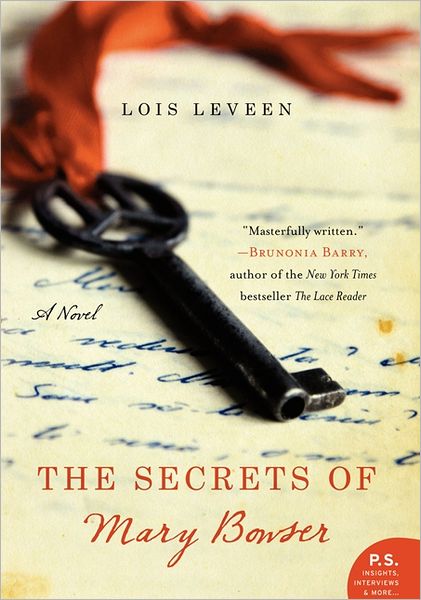
Destined to be on many "best of the year" lists, Lois Leveen has truly brought history to life in The Secrets of Mary Bowser. Starting from the briefest of mentions of this remarkable woman in historical records, Leveen deftly fleshes out the story of Mary Bowser, a freed slave who was educated in Philadelphia and who returned to Virginia to become a spy for the Union during the Civil War. Exploring such weighty topics as slavery, abolitionism, religion and war, this is also a story about family, friendship and the spaces in between.

I know many of you may already have started seeing positive reviews about this novel and some of you might even have review copies. I strongly urge you not to put off reading this one. It does not read like a first novel at all thanks to Leveen's smooth prose and tight story. The story is, in fact, so believable that the reader must constantly remind herself that much of it is only supposition. But if Mary Bowser was even half the woman that she is made out to be, then she deserves to have her story told.

I also had the opportunity to meet Lois at Third Place Books on Tuesday night and hear her read from the book. I even asked a couple of questions, something I rarely do. It was an enlightening evening and led me to an even greater appreciation of the novel. If you happen to be in Birmingham, Alabama, you can go to one of her events tonight!

In awe of those who came before,
K

Tuesday, October 4, 2011

RIP Read 3: The Penguin Book of Gaslight Crime

Besides having the most amusing cover of almost any book I've ever owned, The Penguin Book of Gaslight Crime is a fantastic little collection of late Victorian crime stories. The editor, Michael Sims, deserves credit for a wonderful collection that doesn't include a single dud. Every story in this book was enjoyable and a few were unforgettable.

Though we are all fairly familiar with a famous Victorian detective or two, Sims decided, after working on a collection of stories about the famed gentleman thief Arséne Lupin, that the era's thieves weren't getting the attention they deserved. After reading this collection, I heartily agree.

I hadn't read any of the authors in this volume except for O. Henry and his classic Christmas heartstring-puller "The Gift of the Magi" -- which couldn't be more different from his tale of frontier town trickery, "The Chair of Philanthromathematics". I also read Sinclair Lewis for the first time in this book with his RIP-worthy "The Willow Walk". Though this group of stories turned out to be more witty than terrifying, I'm still going to include it in the challenge because there's many a mystery in the volume -- even if we are viewing them from a more prosecutable angle!
"The difference between you and me is this," Cecil was saying. "You exhaust yourself by making money among men who are all bent on making money, in a place specially set apart for the purpose. I amuse myself by making money among men who, having made or inherited money, are bent on spending it, in places specially set apart for the purpose. I take people off their guard. They don't precisely see me coming. I don't rent an office and put up a sign which is equivalent to announcing that the rest of the world had better look out for itself. Our codes are the same, but is not my way more original and more diverting?" -- Arnold Bennett, "A Comedy on the Gold Coast"
Keeping my hand over my purse,
K

Friday, September 30, 2011

RIP Read 1: The Devil in the White City

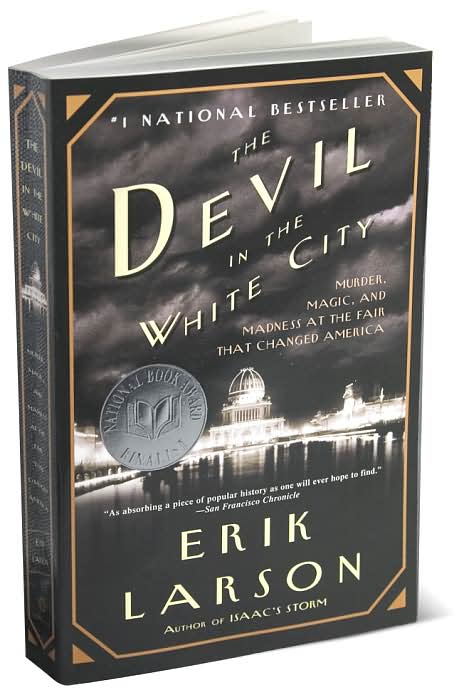
I spent most of September trying to get through The Mysteries of Udolpho but when I was only one third of the way through after almost three weeks, I threw up my hands and threw down the book. I needed something to get me back on track and so I picked up The Devil in the White City by Erik Larson. Thank you to everyone who recommended that I finally read this one! It was just what I needed.

I'm not going to write much about this book because many of you have already read it and others will probably be at least a bit familiar with it. For those who aren't, the long and short of it is that it tells the parallel stories of the Columbian Exposition in Chicago at the end of the nineteenth century and the exploits of H.H. Holmes, a serial killer and all-around creep in sheep's clothing. Larson takes a little bit of liberty and really creates a narrative with the facts that he unearthed to make it a compelling read. (He explains why he did so in the end notes and I accepted his reasoning even though it bugged me a bit while reading.)

My only complaint (and why I gave it 4.5 stars on LibraryThing instead of 5) is that I love science and wanted to read more about Tesla and less about architecture. I know that it would have been a heftier tome if Larson had included everything possible about the fair but I was just a bit sad that the amazing things that were happening at the Exposition were glossed over. Even the first electric chair (thanks a lot, Edison) was only given one sentence.

But, of course, I heartily recommend this book to anyone interested and it certainly made a chilling RIP read. The evil that men do is always worse than any fiction.

Avoiding life insurance policies that benefit relative strangers,
K

Wednesday, March 16, 2011

New Release: LaRue Across America and GIVEAWAY!

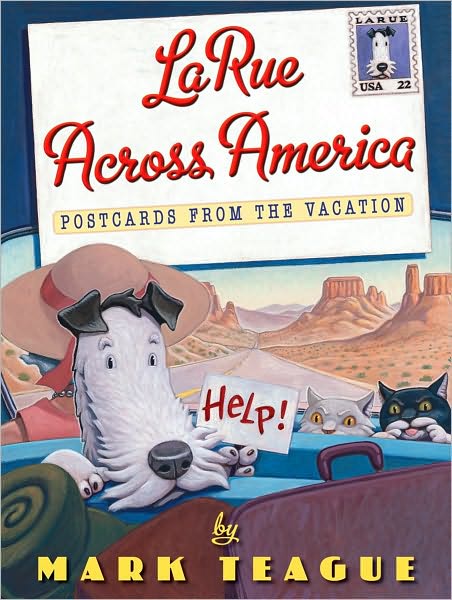
When I first read LaRue Across America: Postcards from the Vacation with Z, I wondered why author and illustrator Mark Teague wrote a book about a dog that can't seem to tell the truth and appears a bit delusional. And then we were lucky enough to see him speak the other night at our favorite indie book store and he explained where Ike is coming from and it all made sense.

Ike is a scamp, a terrier who has had many adventures, each one colored by his own view of things -- namely that he is a saint and the cats next door are holy terrors. This isn't exactly the truth but you wouldn't be able to convince Ike of it! His owner, Mrs. LaRue is wise to him but she also loves the pup. In their latest adventure, Ike and Mrs. LaRue are about to set out on a summer cruise when the neighbor lady faints in the heat and needs to spend some time in the hospital. Mrs. LaRue offers to mind her cats and decides to change their cruise to a road trip across the States. The story is told through Ike's postcards back to their owner, Mrs. Hibbins. As you can guess, two cats and a dog in a car is the perfect setting for hijinks. Add in a water park, the Empire State Building and the Grand Canyon and kids also get an introduction to some of the wonderful things that America has to offer.

We were very lucky to meet Mark Teague, hear him read from this fun book and get our own books signed (we also picked up Ike's first adventure, Dear Mrs. LaRue: Letters from Obedience School). Now we would like to give you the chance to go on your own trip with Ike. Two lucky readers will win a copy of LaRue Across America: Postcards from the Vacation from Scholastic. Fill out the form below to enter (U.S. readers only on this one, one entry per person). Two winners will be picked after end of day on Sunday. Good luck!

Packing our bags,
K and Z


Support our site and buy LaRue Across America: Postcards from the Vacation on Amazon or find it at your local library. We received a copy for review from a publicist.