Showing posts with label Neil Gaiman. Show all posts
Wednesday, April 12, 2017
New Release: Norse Mythology
It is becoming a new tradition for me to sneak a Neil Gaiman read into March Magics/DWJ March each year. Neil was such great friends with Diana and Terry that it just feels right to add him into the mix. Anyway, he obliged me this year by having a new book out-- Norse Mythology --and I was able to fit it in right at the end of the month.
The book title is pretty self-explanatory. Neil read original sources (Prose Edda and Poetic Edda, not in their original language) and, simply, retold the stories in a way to capture modern readers. The time flies by as you read about how the world was formed, how Thor got his hammer, and how Loki is seriously the worst. I'm not a huge mythology person but even I was caught up by each of these tales and transported to another world of giants and serpents and gods. I don't know how Gaiman does what he does but he did it again in this book.
With rapt attention,
K
Friday, April 22, 2016
Spending Time with Neil
As the first casting decisions for the upcoming miniseries came out, I decided it was time to reread American Gods and to see what Neil decided to add back in to the Author's Preferred Text edition. I liked this story much more than I did when I first read it almost five years ago. At that time, I had just gotten started with Neil with books like Coraline and Good Omens and didn't really know to expect sex or violence in his stories. But now that I know him and his work better, there was nothing unexpected in the book and I was more able to focus on the details of the story and the mythology. I can't find where but I know I've seen Neil himself say that his fans can be divided into two groups, those who love American Gods and those who hate it. It is definitely a divisive book, dark and brooding with just a touch of redemption at times. This time through I appreciated the crafting of the characters and the vivid sense of each place that Shadow found himself in. Anyway, the casting decisions so far have been stellar and I'm really looking forward to watching the miniseries hopefully late this year.
The Art of Neil Gaiman is a comprehensive review of almost everything Neil has done in comics, novels, film, and children's books by Hayley Campbell, a young family friend who a journalist and the daughter of illustrator Eddie Campbell. She had access to all of the stray papers in his attic and to him and his memories. It was really interesting to read how his career evolved, which things he loved working on and which were more like "work", and what things he would possibly like to write in the future. This is a book for diehard Gaiman fans and it was a fascinating inside look.
Worshipping at the altar,
K
Friday, July 17, 2015
Four Recent Reads That I Loved
I read some great books over the past couple of months. In no particular order they are
First up, I read Jamaica Inn by Daphne du Maurier when we were in Kauai. I hadn't read any du Maurier in years but this was just as good as Rebecca and My Cousin Rachel. It's quite gothic with brooding good guys and equally brooding evil ones. It definitely put me in the mood for rereads too!
After devouring all of the volumes of Scott Pilgrim this spring, it was time to read Seconds by Bryan Lee O'Malley. This was a super awesome story about second chances and unintended consequences.
I don't know why I finally gave in and read my last unread Gaiman but Anansi Boys called to me and I couldn't resist. It was as good as expected with great characters and mythology. But now I am without a Gaiman on my TBR shelf. I guess now he just has to hurry up and write something new!
Are any of these books on your favorites list?
Filling the keeper shelves,
K
First up, I read Jamaica Inn by Daphne du Maurier when we were in Kauai. I hadn't read any du Maurier in years but this was just as good as Rebecca and My Cousin Rachel. It's quite gothic with brooding good guys and equally brooding evil ones. It definitely put me in the mood for rereads too!
I wanted to read Andy Weir's The Martian before the upcoming movie but had to wait for hubby to read it first since I technically bought it for him. (I'm sure I'm not the only one who does that!) It was a super compelling read and I loved Mark Watney. Now I can finally watch that movie teaser trailer!
After devouring all of the volumes of Scott Pilgrim this spring, it was time to read Seconds by Bryan Lee O'Malley. This was a super awesome story about second chances and unintended consequences.
I don't know why I finally gave in and read my last unread Gaiman but Anansi Boys called to me and I couldn't resist. It was as good as expected with great characters and mythology. But now I am without a Gaiman on my TBR shelf. I guess now he just has to hurry up and write something new!
Are any of these books on your favorites list?
Filling the keeper shelves,
K
Wednesday, April 8, 2015
A Pair of Shorts: Neil Gaiman and Kelly Link
I'm way behind on reviews so
a) since I bought these books together on the same day (I had to get my signed Gaiman!)
b) they're both short story collections
and
c) the two authors are at least friendly (I'm not sure if they're officially friends or not but I have a feeling they are),
I'm going to let them share one post!
First, I read Neil Gaiman's Trigger Warning: Short Fictions and Disturbances. Now that I am usually pretty current with all of Neil's various undertakings, I had read a few of these stories in their primary works/collections. Still it was nice to revisit those and to also read some new poems and stories.
I choose different ways to record short stories in my Official Short Story Recording Notebook and, for this one, I did ratings of 1-5 with 5 being best. Of the 36 pieces (breaking A Calendar of Tales into each month), I rated 30 of them as a 4 or a 5. Obviously this collection really worked for me, from the awesome "The Man Who Forgot Ray Bradbury" (which made me cry when I first read it in Shadow Show and Neil was not sorry) to "The Truth Is A Cave in the Black Mountains" (which confused me a bit the first time in Stories, clicked when I read the illustrated version, and finally became a favorite this time through), to the brilliant Holmes story "The Case of Death and Honey", and the exceptionally dark "Black Dog", featuring Shadow from American Gods.
I truly think this is a collection that has something for every reader. There will also be lots of stories that will make many readers uncomfortable but it seems that that is partially what Gaiman set out to do with a title like Trigger Warning and stories with "images or words or ideas that drop like trapdoors beneath us, throwing us out of our safe, sane world into a place much more dark and less welcoming."
I had mixed results with the first collection of stories I read by Kelly Link (her YA-focused Pretty Monsters which I really wish now I hadn't given away!) but I was still looking forward to Get in Trouble. This collection only has nine stories but they were great. I only was unsatisfied with one of them ("I Can See Right Through You"), mostly because I didn't like the characters or care about their dramas. I did mention a fantastic character name on Twitter (Bunnatine!) and Link responded that she got the name from this fabulous lady. And, probably not coincidentally, one of the stories from this collection was also in Shadow Show ("Two Houses") and I enjoyed it even more on this second read.
My biggest (still little) complaint with Pretty Monsters was that the stories were so short that I was left wanting more of the tiny worlds she had created. I didn't feel that at all this time. It was a very satisfying read and Link will be on my list of authors to follow going forward!
Reading short shorts,
K
a) since I bought these books together on the same day (I had to get my signed Gaiman!)
b) they're both short story collections
and
c) the two authors are at least friendly (I'm not sure if they're officially friends or not but I have a feeling they are),
I'm going to let them share one post!
First, I read Neil Gaiman's Trigger Warning: Short Fictions and Disturbances. Now that I am usually pretty current with all of Neil's various undertakings, I had read a few of these stories in their primary works/collections. Still it was nice to revisit those and to also read some new poems and stories.
I choose different ways to record short stories in my Official Short Story Recording Notebook and, for this one, I did ratings of 1-5 with 5 being best. Of the 36 pieces (breaking A Calendar of Tales into each month), I rated 30 of them as a 4 or a 5. Obviously this collection really worked for me, from the awesome "The Man Who Forgot Ray Bradbury" (which made me cry when I first read it in Shadow Show and Neil was not sorry) to "The Truth Is A Cave in the Black Mountains" (which confused me a bit the first time in Stories, clicked when I read the illustrated version, and finally became a favorite this time through), to the brilliant Holmes story "The Case of Death and Honey", and the exceptionally dark "Black Dog", featuring Shadow from American Gods.
I truly think this is a collection that has something for every reader. There will also be lots of stories that will make many readers uncomfortable but it seems that that is partially what Gaiman set out to do with a title like Trigger Warning and stories with "images or words or ideas that drop like trapdoors beneath us, throwing us out of our safe, sane world into a place much more dark and less welcoming."
I had mixed results with the first collection of stories I read by Kelly Link (her YA-focused Pretty Monsters which I really wish now I hadn't given away!) but I was still looking forward to Get in Trouble. This collection only has nine stories but they were great. I only was unsatisfied with one of them ("I Can See Right Through You"), mostly because I didn't like the characters or care about their dramas. I did mention a fantastic character name on Twitter (Bunnatine!) and Link responded that she got the name from this fabulous lady. And, probably not coincidentally, one of the stories from this collection was also in Shadow Show ("Two Houses") and I enjoyed it even more on this second read.
My biggest (still little) complaint with Pretty Monsters was that the stories were so short that I was left wanting more of the tiny worlds she had created. I didn't feel that at all this time. It was a very satisfying read and Link will be on my list of authors to follow going forward!
Reading short shorts,
K
Tuesday, October 21, 2014
RIP IX: The Truth Is in the Graveyard
Neil Gaiman kindly obliged me this RIP season by having some nice new books out to enjoy.
First, there was The Truth Is a Cave in the Black Mountains. This is an illustrated version of a short story that was published in the collection Stories a couple of years ago. I liked but didn't love the story when I read it before but, whether it was because this was a second read or because of the illustrations, I liked it more this time through. Some things that passed me by the first time were made clearer. The illustrations by Eddie Campbell were, in some cases, just as telling as the words themselves. In fact, the subtitle of the book is "A Tale of Travel and Darkness with Pictures of All Kinds". The illustrations aren't black and white but they are realistic and, when necessary, dark. I'm glad that I picked this one up and gave the story another chance.
And, as soon as I saw that there were going to be graphic novel versions of The Graveyard Book, I got very, very excited. I bought the first one for read-a-thon and then Chris said he already had the second volume too so I bought that as well. I read both of them in the middle of the day and, honestly, rushed through them too quickly to really appreciate them. Still, I thought they were fantastic. Each chapter is done by a different illustrator and they each bring something different to the story. I liked some of the styles more than others but didn't hate any of them. The thing I was least ready for was the fact that by turning this story into a graphic one, it is no longer a children's story. In my opinion, these were made for adults, bringing the story to another audience. I can't wait to reread them and to pay more attention to the details.
The final new Gaiman of the month isn't being released until October 28 so I might not actually get to it until the beginning of November. It's a graphic retelling of Hansel and Gretel, illustrated by Lorenzo Mattotti and put out by Toon Books. I'm curious to see what they do with this well-known tale.
Gaga for Gaiman,
K
Monday, August 25, 2014
Short Story Summer: Update Two
I managed to fit in two more books of short stories this summer, bringing my total to four books and dozens of stories.
I have read Neil Gaiman's Fragile Things more than once but hadn't yet read Smoke and Mirrors: Short Fictions and Illusions. This book of stories and poetry covered a wide variety of styles and themes but the only thing that didn't vary was the quality of the writing. (No duh, right? It's Neil.) There are a few stories in this collection that I'm sure I'll revisit regularly.
I had started this collection, Unexpected Magic: Collected Stories by Diana Wynne Jones, a few times but hadn't progressed past The Plague of Peacocks. This time through, I skipped a couple of stories that I had just read in another collection, reread a couple of favorites (The Girl Jones, What the Cat Told Me and Dragon Reserve, Home Eight) and took my first trip down Everard's Ride. I adored these stories (and one novella) so much that I can't even find words to explain. My journal has little hearts next to all of the story names. I even think that Jenny's Law (DWJ is always better on reread) is going to be proven wrong for once because there's no way that I could love Everard's Ride more. I already love it the most possible. And why did Dragon Reserve, Home Eight never become a full novel or series?!
This was a really fun project and I cleared four books off of the TBR. Yay! I deem this Short Story Summer a success.
Briefly,
K
Monday, August 12, 2013
My Night With Neil
As those of you on Twitter probably know (I might have mentioned it), I had the chance to head up to Vancouver, BC a couple of days ago to catch Neil Gaiman on the last of his North American signing dates. We drove up on Thursday morning and got into town around three in the afternoon. We checked into our hotel and got a quick lunch and then I was dropped off at the Vogue Theatre, an historic art deco theatre built in 1941. Besides being a bit warm in the sun, the 75 minute wait outside didn't actually seem that long because I was so excited.
Once inside, I got a seat just off-center in the fourth row and had another hour to wait until Neil was on. Luckily I brought a book to pass the time (thanks, Connie Willis).
Then Neil came out (hooray!). I didn't get any good photos while he was on stage but I didn't try very hard either. Instead I sat back and listened while he read from The Ocean at the End of the Lane, answered a wide variety of audience questions and read once more from Fortunately, the Milk (an all-ages book out in September and really, truly hilarious). This part of the night flew by even though it lasted for about 90 minutes. He was funny and thoughtful and did his best to boost the confidence of the Canadian audience (that's a Canadian joke).
Then, the signing. Luckily, my wait was only about two hours long, as our row was called at about 9:55pm. (I say luckily because there was still easily half of the theatre that were still waiting patiently when I left.)
I was surprisingly not too nervous as my time came to get my books in front of Neil and there was a very kind volunteer there to take our phones and cameras so I got some fantastic photos of myself with himself.
At first I just stood there awkwardly while he signed my copy of Ocean (drawing a nice moon inside) and then I told him I came up from Seattle and he thanked me for doing so and I felt a bit calmer.
And then he got to the other book I brought for him to sign, Diana Wynne Jones' Reflections: On the Magic of Writing, which he wrote the foreword to and he just paused and sighed. Then he started telling me how he wished Diana had gotten the chance to read Ocean and that she probably would have loved it (I said I thought so too). I might also have mentioned #dwjmarch ...
We talked about missing her dreadfully and a bit about her new book (the one that her sister Ursula has written the ending to -- Neil was considered for the project but decided to say no to it) ...
And that was it ... time for one last smile and then he had to sign that book for the nice boy with the awesome hair that was behind me.
It was one of the most amazing nights of my life and it took me hours to fall asleep that night. I am so happy that the Vancouver Writers Fest was able to bring Neil to BC and that my kind husband and son drove with me all the way to another country "just" to see an author.
Still reliving a night to remember,
K
Sunday, June 16, 2013
New Release: The Ocean at the End of the Lane
Best. Book. Of. Ever. The End.
You are going to see a lot of reviews like this over the next few days and weeks and months about The Ocean at The End of the Lane by Neil Gaiman and here are some of the reasons.
- It's got a gorgeous cover and a mysterious title which hopefully means lots of readers will pick it up and give it a try. If they do, they're probably going to love it.
- It isn't a long book, only 178 pages, so it's easy to get through in an afternoon or evening. Many readers will do just that. I finished it less than twelve hours after it landed on my door step. It would have been sooner if I hadn't had to eat or take care of my child.
- It's a perfectly-paced, imaginative, slightly-dark tale full of beauty and wonder, sadness and love. Pretty much, it's a perfect Neil Gaiman story. It's also just a perfect story.
- It's a great entry novel for readers who haven't tried Gaiman before. It's easy but incredibly deep -- kind of like Lettie Hempstock's ocean (which you'll have to read the book to find out about).
I could go on about characters without names, opals, kittens, water and shadows but those are just details, bits of the story. The perfection of the tale is how Gaiman brings it all together, holding the reader's hand through nostalgia, comfort, sadness, fear and forgetfulness. So when you see the positive, gushing reviews, let them lead you to your local indie bookstore where you can pick up a copy.
Starting back at the beginning,
K
Wednesday, April 17, 2013
Stardust Read-Along: Second Half
Time for the second half discussion of Stardust by Neil Gaiman. As was the case last week, there will be spoilers in the answers.
1. In the first part we saw a naive, wool-headed and self-involved Tristran. What are your thoughts about Tristran and his personal journey now that the book has ended?
I really liked Tristran all through his journey. Even when he was young and naive, he was earnest and hopeful. And then he was cautious but still honest and he truly seemed to enjoy all of the new feelings and new experiences he had. It was a bit callous that he left his father and family forever in the end but he was changed enough by Faerie that I don't think he could have gone back to life in Wall.
2. The star, who we now know as Yvaine, also experienced a transformation of her own. So I ask the same question, what are your thoughts about Yvaine and the journey she took?
I also liked Yvaine through the whole story. Her initial reactions were understandable and I don't think she ever did anything unreasonable. I did feel sad for her in the end, that she lived so long, alone. It was unavoidable but I really hoped for a fairy tale ending to this fairy story. Still, she got a chance to live and love and not be hacked to pieces so that's always nice.
3. The villains of the story came to interesting ends, but not necessarily expected ones. How do you feel about Neil Gaiman's handling of the Stormhold brothers (who had remained at the end of Part 1) and the two witches, the one Lilim and Ditchwater Sal?
It's strange but I felt sad for the brothers even though they were, well, murderous. They never saw their fates coming and, truly, I didn't see them as villains. They were only acting out what their heritage demanded of them. The witches, however, were definitely villains. The Lilim sister definitely got what she deserved. It was satisfying to see her destroyed and decrepit. Ditchwater Sal was more of a passive villain but I definitely think things ended for her in an acceptable way.
4. Were there any descriptions, characters, settings, plot threads that stood out to you personally during this second half of the book?
The idea of Tristran and Yvaine ending up on a cloud and then being picked up by an airship? Amazing. And then this description of being on the clouds --
"Looking out over the world from above, he could never remember feeling so alive as he did at that moment. There was a skyness to the sky and a nowness to the world that he had never seen or felt or realized before."
5. At the very end of the book we see that Tristran and Yvaine's relationship and fate echoes that of Aragorn and Arwen from The Lord of the Rings. If this question makes any sense to you (lol), what comparisons and/or contrasts do you see, especially in the fates of Yvaine and Arwen?
Love is stronger than death, I suppose. However, Arwen chose to give up her immortality for a life with Aragorn whereas Yvaine didn't seem to have a choice or a death. She already had lost her position in the sky before she met Tristran and she retains her "sparkle" and immortality even as the years pass. I think that Yvaine's situation is much sadder than Arwen's.
6. What are your overall impressions of the story now that it is done?
I liked this book the first time I read it but now I think I love it. It's a perfect balance of fairy tale and adult story with actually quite realistic events and consequences when you think about it. Tristran ends up with a damaged hand, Yvaine retains her limp. There's no perfect ending but there are plenty of perfect moments.
7. If Gaiman were to return to Wall/Faerie, would you take another journey there? If so, are there any adventures hinted at in Stardust that you would like to see Neil expand on?
I would love a story about the lightning collectors. I'm curious about Mr. Bromios' story too. The modern day Wall story that Neil was originally going to tell doesn't interest me as much though but I'm sure I would read it (and probably love it).
Watching the stars,
K
Wednesday, April 10, 2013
Stardust Read-Along: First Half
As part of the Once Upon a Time VII Challenge, Carl is hosting a Stardust Read-Along. It's a fairly short book so we're writing about the first half today and the second half next week. If you're not familiar with this book, it's about a boy, Tristran Thorn, from a town called Wall, located on the border of Faerie. To please a girl (who perhaps doesn't deserve his attentions), he sets off into Faerie one day to search for a fallen star. The story is full of colorful characters--both good and evil--and strange lands.
Now, since this is a read-along discussion, there be spoilers ahead. So, if you haven't read the book yet, leave now and take this time to add Stardust to your TBR or place a library hold.
I feel like Tristran had a lot to learn about the human world so it was strange that he went to a place that he knew even less about. So far, he's very trusting and that will likely get him into trouble -- even more than he's already experienced. But, he also seems to have a gift that will hopefully help him and balance it out. The star, on the other hand, seems very worldly and wily for someone who has just arrived hours before.
2. There are some very interesting potential villains introduced in this first half of the book. Do any of them particularly stand out to you? If so why or why not?
The villains in this book are chilling and creepy. I think they all stand out, maybe more than the protagonists at this point. The brothers Septimus and Primus have said little but their singlemindedness is obvious. The sisters Lilim are much more chatty and catty and are disturbing, verging on terrifying. Together they are very strong and I have vague memories of what is to come in the second half and I'm not particularly looking forward to reading some of it!
3. In Chapter Three, just after the section with the brothers in Stormhold, Neil Gaiman gives us a description of Faerie that includes "each land that has been forced off the map by explorers and the brave going out and proving it wasn't there...". What imaginary lands do you then hope are a part of Faerie?
This line stood out to me too. It's beautiful and I didn't think of it so much as related to imaginary lands but more of "lost lands" like the American prairies full of buffalo and wolves and wild horses or the oceans full of gentle whales and non-bleached coral, and even pollution and dam-free rivers throughout. There are, of course, unicorns and, hopefully, dodos and tasmanian tigers and all of the other species that have been "forced off the map".
4. We do not get to spend a great deal of time in the market but while there we are given a number of interesting descriptions of the wares being bartered or sold. Which if any of them caught your eye, either as items you would like to possess or ones you would most certainly hope to avoid.
Everlasting lavender sounds wonderful. The line about coats ("Coats of night! Coats of twilight! Coats of dusk!") sounded like a description of the contents of Neil Gaiman's hall closet. ;) And, after vacuuming gobs of cat hair today, the crystal cat sounds nice right about now.
5. If you have read much of Gaiman's work, particularly his short fiction, then you have come across some rather graphic and disturbing portrayals of sex. Gaiman offers up something very different in the way of a sex scene early on in Stardust. What are your feelings of the scene either in general or as a contrast to other Gaiman-penned scenes involving sex?
![]() |
| gratuitous Ben Barnes picture |
It was strange because I've read this book before but I remembered it as much more tame than it really is. I had completely forgotten this sex scene -- which is probably a good thing because the ones that tend to stick with me are Gaiman's more horrific or graphic ones (like the beginning of American Gods). I still get really uncomfortable every time I read one of his sex scenes. His mild-mannered exterior hides a very graphic imagination, doesn't it?
6. I suspect Neil Gaiman is influenced by a number of fairy and folk tales in Stardust. Are there any elements of the story that made a particular impression and/or reminded you of other fairy stories you have read or are familiar with?
I am terrible with specific fairy tales but so many of the general ideas are there -- maidens and unicorns, long-distance travel by candle (similar to seven-league boots), witches, forests with evil intent. It's all somewhat familiar but also presented in a way that feels fresh and different.
7. And finally, which of the many side characters introduced have caught your eye and why? Or what else about the story thus far is of interest to you?
I really like the "little hairy man", Tristran's first companion in Faerie. He seems honest and kind and a bit lonely. He repays a decades old debt in an uneven manner -- meaning the things he does for Tristran seem to be of much more value and breadth than just a place to sleep, which is what he was given by Tristran's father. I hope to see him again in the second half though I don't know how Tristran will get back to him.
I'm really excited to read the second half of this book. It's a much different experience than I remember from the first time, possibly because I've read even more Gaiman now and I just feel like this strange land is still somehow familiar.
Prepping for more adventure,
K
Sunday, October 30, 2011
Fragile Things Group Read: Four Stories and Wrap-up
After two months of time spent in the twisted but sometimes glorious imagination of Neil Gaiman, our time together is coming to an end. This was the last week of readings. It will be strange to finally put this book away for a time. I've loved reading it in small doses and I didn't skip any stories like I did the first time I read it. I think I understood so many of them in a different way now that I know Gaiman's writing better. This has actually put me in the mood to re-read Coraline soon! Thank you again to Carl for hosting this read along and keeping us all on task each week.
THE DAY THE SAUCERS CAME
This is probably my favorite piece of the entire collection and I was patiently waiting for its time to come. It is creative and funny and light-hearted in an incredibly nerdy way. Not only all of that, but it reminds me of my teen years, sitting by the phone, oblivious to anything that was happening around me because I was so self-absorbed and I thought the world revolved around boys and friends. I missed out on so much during those years in the world and even in my own family -- but nothing as dramatic as "the saucer day, the zombie day The Ragnarok and fairies day, the day the great winds came ..."
SUNBIRD
This is one of the few stories that I remembered vividly from my first reading of this book. There are so many ways to look at it -- as an exploration of myth, a study of eternal life and even as a story from father to daughter. The phoenix is always an interesting idea but to pair it with the idea of living eternally through your children--as they pick up in life where you left off--I think it's interesting. It's a much less literal interpretation of the phoenix and that's something that I like about Gaiman's writing. Sometimes he presents things in their most basic form but other times he gives a story or a myth a little twist that takes it somewhere that it has never been before.
INVENTING ALADDIN
And I really enjoyed this story as well! It's just a brief look into the mind of Scheherazade and what she goes through each day, her life dependent on the ability to imagine one more tale or to satisfactorily continue the current one. She's not just a storyteller. She's a sister and a mother and a housekeeper. And yet, only her stories keep her alive. It's sad and hopeful at the same time.
THE MONARCH OF THE GLEN
I can honestly say this collection ended on a high note for me because I breezed through this novella -- enjoying the chance to follow Shadow again through Scotland. Smith was more likable in this story and Mr. Alice, well, let's just say he was tolerable. And it made all the difference in the world (obviously) to have finally read American Gods this year. I might not have even read this story the first time (I couldn't remember it at all which means I probably didn't) but this time I was happy to revisit one of Gaiman's best characters. Now I just need to visit Scotland (and hope that Grendel isn't still hanging around).
Putting it on the shelf,
K
Putting it on the shelf,
K
Sunday, October 23, 2011
Fragile Things Group Read: Four Stories
I almost forgot to do my Fragile Things reading for this week! Life got in the way, as it sometimes does. But luckily I remembered to grab my book and here we are. My responses are pretty short this week. I don't know if it's because we've been doing this for so long or just because there wasn't much to say.
(By the way, if you don't know about Gaiman's All Hallow's Read initiative--gifting scary books on Halloween--check out this video about it. I still haven't quite decided what I'm going to do but I want to participate.)
IN THE END
Well, I'll admit that I don't have a clear idea what this single page story ultimately means. It's a backwards take on the Adam and Eve story. I've read it a couple of times and, really, I just don't know. He says in the introduction that he "was trying to imagine the very last book of the Bible". I guess it's just a re-winding of everything -- like a yo-yo returning to God's hand.
GOLIATH
This is a rare science-fiction story in this volume and I loved it. It's bleak and Matrix-y (as it should be because it was inspired by the script for the film The Matrix) but it's also beautiful in a weird way. It's about humanity and disposability and uniqueness and homogeneity. I really can't explain it but this is one story that I can always go back to for a thought-provoking read. The main character, "Goliath", is no Neo. He's something else all-together -- someone who is meant to be a savior but not of mankind. Rather, he is a savior for the machines. Crazy.
PAGES FROM A JOURNAL FOUND IN A SHOEBOX LEFT IN A GREYHOUND BUS SOMEWHERE BETWEEN TULSA, OKLAHOMA, AND LOUISVILLE, KENTUCKY
And here is another piece inspired by Tori Amos and I just don't like it. It seems like it's trying too hard to be etherial and mysterious. Gaiman says it's in the American Gods world but I didn't see that so much. A mysterious identity-shifting narrator, an unrealistic driving journey around the United States, impossible dates -- they just didn't come together to make anything that worked for me.
HOW TO TALK TO GIRLS AT PARTIES
This is a strange story. It's fantastical but also somehow bland. I guess I'm just kind of neutral about it. I can't even think of anything really to say because, though it is rather vague, I also feel that it is fairly straight-forward.
With my eyes on the finish line,
K
With my eyes on the finish line,
K
Sunday, October 16, 2011
Fragile Things Group Read: Four Stories (Starting with a Poem)
Last week's reading had some real gems in it and a lot of discussion which was fun! Let's just get into this week's "things" --
(As always, these are short stories and poems so there are bound to be SPOILERS ahead ...)
MY LIFE
Okay, this might be the first time I have found anything really funny in this volume. This free-form piece was just like a country song -- "my dad was blind but then he could see so he divorced my mom who became my dad after my dad died from being hit by alien debris from outer space". And that's just the first verse! The drunk on a barstool is always good for a story or two, right? And the thought of that drunk being a sock monkey just pushes this all over the edge into pure hilarity.
FIFTEEN PAINTED CARDS FROM A VAMPIRE TAROT
Unlike my feelings about the "Strange Little Girls", I loved these vampire studies! It's strange to think of them paired with the art of Rick Berry though because they are so much more vivid than Berry's blurred art. I can't find why it's called "Fifteen Painted Cards" when there are twenty-two. Did anyone find that out? Anyway, I don't think there was a bad one in the bunch here.
FEEDERS AND EATERS
This story is gross and gory but still a good read. It's interesting that it came to Gaiman as a dream (or as he says, a nightmare) because, if I had dreams like this, I would never sleep again. I'm happy that I read this while it was still light outside and not right before bed because I would be afraid to sleep. Is the woman a vampire or a cannibal? I don't know but she sure ain't right.
DISEASEMAKER'S CROUP
This piece is indeed "...a netherworld of pseudo-medical nonsense." It takes one a little while to realize that the problem is not in the reading of this piece but in the writing. The brain tries to make sense but it is really nothing but nonsense. I think if one admitted to liking this, one's mental condition would be questioned. And yet, how can one not enjoy a bit of tongue-in-cheek nonsense every once in a while?
Living a normal life,
K
Living a normal life,
K
Sunday, October 9, 2011
Fragile Things Group Read: Four Stories (Includes Poem-ish Things)
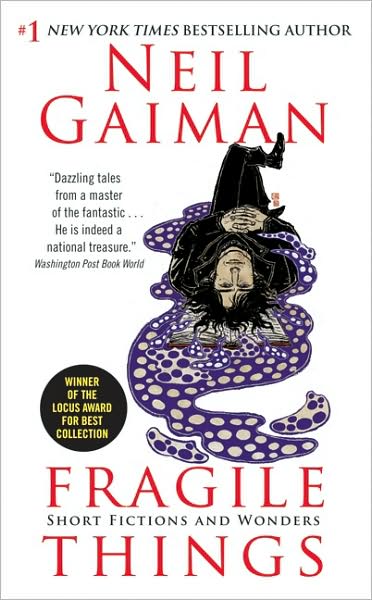
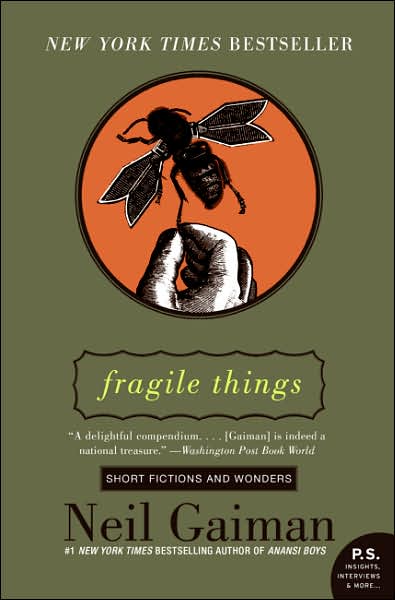
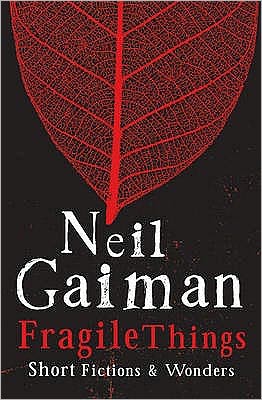
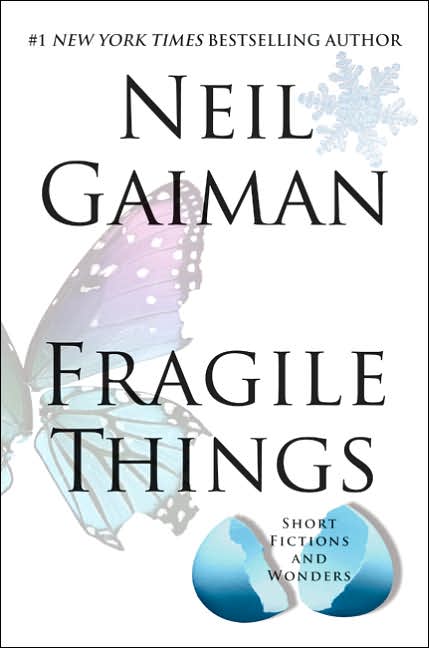
And we come back around to this Fragile Things cover, the beautiful one I get to enjoy during these two months. Though you can't tell from the image, the cover is actually vellum with the text and eggshell printed on it and the butterfly and snowflake are printed on the white book cover underneath. That's what gives them the faded appearance. They look different in real life than in this image -- less like pictures and more like actual specimens.
We're halfway through the group read and it's interesting to spend this much time thinking about a set of stories and poems. For days I thought about the comments on last week's post including those about Tori Amos and then, with fantastic timing, my iPod decided to play "Little Earthquakes" the other day when it hasn't "randomly" chosen Tori Amos in months. Carl was right -- her songs are still hauntingly beautiful and I think I will spend a little more time with her earlier albums this fall. And yet, maybe I'm spending a little too much time with Mr. Gaiman. Recently I had a dream that I woke up and Neil was waking up at the same time -- in my bed. There's wasn't anything going on, we had just, literally, become bedfellows. Anyway ...
(remember, there might be some SPOILERS ahead ...)
LOCKS
This is a beautiful little free-form piece about parenthood and story-telling that was written for Neil's daughter when she was two. You can read it here and there are plenty of videos out there of him reading it. It's about a father telling his two-year-old daughter the story of Goldilocks and also contemplating his own role as a Father Bear. He says in the introduction that stories are "the currency that we share with those who walked the world before ever we were here. (Telling stories to my children that I was, in my turn, told by my parents and grandparents makes me feel part of something special and odd, part of the continuous stream of life itself.)" I wasn't told many stories when I was a kid (although my dad would make up the most hilarious songs sometimes), but I know that my time reading with Z is a special time where we share a story. We may not experience it in exactly the same way or be looking to get the same things out of it, but the moment is there for us to remember, each in our own way.
THE PROBLEM OF SUSAN
I don't have any real connection to The Chronicles of Narnia. I read them when I was a kid (or most of them at least -- I can't really remember) and thought they were fine but I didn't love Narnia the way I loved Oz. So, I didn't recall what had happened to Susan and the others. But I do remember that Aslan and the White Witch never had dirty s.e.x. and Aslan never ate children. I have yet to be comfortable when Gaiman writes explicitly dirty things. It kind of ruins everything else around it for me because it rarely seems super relevant. I mean, Aslan could have still eaten Susan and Lucy without stopping for nookie in the middle, right? This story could have been okay (and was really thoughtful about the elderly Susan in parts) but really lost me toward the end there. I just searched for "gaiman susan" in the Googles and the second thing there after the Wikipedia entry on Susan Pevensie was the wonderful Jenny and her thoughts on this story from January 2009. You should go read what she says. It's smart and stuff and the comments go on for ages. It seems this story is thought-provoking for a lot of readers (who don't all have the same interpretations of it).
INSTRUCTIONS
Here is another free form poem that you can read online. It has the unique distinction of also having been turned into a picture book last year, illustrated by Charles Vess. Here is the book trailer that also includes the whole piece, read by Neil himself --
While I was embedding this, Z sat down and watched and listened with me. He seemed to like it quite a bit. This was strange because when I read it from my book just moments before, I thought it felt old and dark and my imagination took me to slightly frightening places that I didn't think were quite appropriate for children. But when Z was presented with these pictures along with the story, these ones with muted colors and only hints of danger, it was okay for him. And I think that's kind of the point of this piece. The instructions are for a journey through fantasy worlds -- whether it be the literal journey that Z still believes in (especially when he sees it right before his eyes) or the mental one that I took when I was reading. The instructions are a bit vague because the journey isn't the same for everyone. But the basic ways of getting through trials, both in fantasy and in life, are similar for most --
"Remember your name.
Do not lose hope--what you seek will be found.
...
Trust dreams.
Trust your heart, and trust your story."
HOW DO YOU THINK IT FEELS?
And then again with the s.e.x. I'm a bit perplexed by the order of the pieces this week. How can a poem, fit to be turned into a children's picture book, be nestled between two stories that are so incredibly adult? And this one isn't only very adult but it's very male. I got more and more annoyed as I read the story. Years later they meet up and she's still beautiful and trim but he's overweight and balding and she wants him more than ever? Of course. Although, I think this did finally clarify some of my thoughts on Gaiman and his writing of sex. At the start of the story, when the man and woman are young and in love, it's glossed over and barely mentioned, just a small part of all the things the couple does together and what their relationship is about. But later, it turns explicit when it's connected to sadness and anger and is the last remaining connection between them -- when it's no longer really love. Not my favorite story of the week (obviously) but I kind of get it.
Not thinking about how it feels,
K
Sunday, October 2, 2011
Fragile Things Group Read: Four Stories (No Poems)
It's another week and we seem to have earned a respite from poetry this week in our Fragile Reads schedule. Not that Mr. Neil is not a competent poet but it really does take a lot for me to love a poem (as you will see toward the end of October where I will finally gush over a poem).
Standard warning: mild SPOILERS ahead.
GOOD BOYS DESERVE FAVORS
I might have recognized the title of this piece if I had been a bass clef musician but, alas, I am mainly a treble clef one and I only know FACE (the notes between the lines of the staff) and EGBDF (the notes on the lines -- did I ever know an acronym for them? I don't recall). Well, apparently the notes between the bass clef staff are ACEG and the ones on the staff lines are GBDFA -- Good Boys Deserve Favors Always. As you can probably guess by now, this is a story about imaginary "young Neil" and his experience with the double bass. I would assume that the "real Neil" was never so fortunate as to escape an embarrassing situation with a celebrity by being possessed by his double bass and playing an amazing piece that saved the day. This is a simple story and might be one of my favorites. It's so matter of fact and then the little "haunting" is slipped in as if it was no big deal. The ending is sad but fitting and I think this is a very satisfying piece.
THE FACTS IN THE CASE OF THE DEPARTURE OF MISS FINCH
The thing with this story is that I'm not sure if it's a good weird or a bad weird. I have really mixed feelings when I finish reading it. Was it too over-the-top, too strange without that certain something that gives it heft and cohesion? Maybe. I did like, however, the way that Gaiman played with the sentence transitions between sections to change the mood, lend a sense of movement and urgency to the story. I don't think this one will ever be a favorite but I don't really mind reading it.
STRANGE LITTLE GIRLS
I used to like Tori Amos more than I do now. I think I just became too content, too satisfied in life to connect with her particular brand of angst and sadness. The music is still beautiful but the lyrics break my heart. And I think I once would have found these "twelve very short stories, written to accompany Tori Amos's CD Strange Little Girls" interesting but now I find them dreary and depressing.
HARLEQUIN VALENTINE
And, to finish the week, I was rather meh on this one as well. I could see how the story was inspired by the artist Lisa Snellings-Clark's brilliant little Poppets but it didn't grab my heart (haha!). Maybe like the previous piece, it was just too sad and bleak. I'll admit that Neil's descriptions of February made me shiver though!
So, one favorite this week and three neutrals. That's still better than the revulsion of last week!
Sticking to the simply supernatural,
K
Sunday, September 25, 2011
Fragile Things Group Read: Four Stories
This week just flew by and I totally was not able to do the story-a-day thing. Still, I wrote about each piece after reading it and that seems to have worked okay (except for a lack of good "absorbing" time).
Again, minor SPOILERS so be aware --
GOING WODWO
From the introduction: "A wodwo or wodwose, was a wild man of the woods." And while it's a very interesting word, I think the key word in the title of this short piece is "Going" because this is really a poem about the transition from a "regular" life to the escapism and communion of the wodwo lifestyle. The narrator talks about what he is leaving behind and the hardships of starting to live off the resources in the forest. At one point, you almost think he will give it up and head back but then he realizes that the spiritual gains outweigh the physical trials. This is a very thought-provoking piece and is an interesting addition to this collection -- though it certainly exposes a few "fragile things".
BITTER GROUNDS
There was nothing wrong with this story. But I don't like Santeria or zombies and so I didn't really like this either. It was well written but it wasn't for me. It just made me sad and uncomfortable. It's strange because I like fantasy magic A LOT but this particular flavor of New Orleans magic, the kind that is always associated with evil and never with good, just seems pointlessly dark to me -- kind of like the bitter grounds left after brewing strong, black coffee.
OTHER PEOPLE
The most puzzling thing about this story is the title. Interestingly (and according to the introduction), it wasn't Gaiman's title for the piece. He called it "Afterlife", which makes much more sense to me. This is a brilliant little story that truly proves a well-known quote --
"We are each our own devil, and we make this world our hell." -- Oscar Wilde
KEEPSAKES AND TREASURES
This was one story that I wanted to re-read again now that I've finally read American Gods because it's supposedly set in the same world. It turned out to be incredibly disturbing and revolting. I didn't remember much about it as I was re-reading it, which means I probably put it out of my mind, trying to not absorb any of its darkness. Though there were many dark and violent things in American Gods, there was nothing quite like this and for that I'm glad. I'm wondering if there will be anyone in the reading group that truly likes this story.
Hoping for something bright and beautiful next week,
K
Sunday, September 18, 2011
Fragile Things Group Read: Four Fragile Things
Continuing on (and featuring another of the covers that this collection has been published with) ...
(Please know that there might be minor SPOILERS in this post.)
First, I would like to say that I did, in fact, go back and read The Fairy Reel out loud this week and it made a difference. I understood it a bit better and now I want to listen to Neil himself read it as well.
THE HIDDEN CHAMBER
And I also read The Hidden Chamber out loud and I still didn't entirely understand it. Originally I didn't really remember the tale of Bluebeard though. And then I went and looked up the Bluebeard story and it made a lot of things clearer once I remembered what it was about. The ghosts are the Bluebeard character's previous wives and the piece is addressed to the current (and final?) one. It's strange to have such a violent man speaking with such a calm and rational voice -- even setting free a butterfly that has strayed into the house. But then you realize that it's not a calm voice but a cold and creepy one. And that he actually tells the woman that it would be best if she ran before ... well ... ::cue finger across the throat motion::
FORBIDDEN BRIDES OF THE FACELESS SLAVES IN THE SECRET HOUSE OF THE NIGHT OF DREAD DESIRE
I think I was tricked by this story again. You start by reading the writings of a somewhat shoddy author who seems to have an incredibly over-active imagination and who writes mainly in clichés of the horror genre. Then you see the author's own life interspersed -- and it's a life of clichés and ridiculously horrifying happenings! This was one of Neil's early stories, one that was tucked away in the attic for years. Should it have stayed in the attic? I don't think so. Though it's not a brilliant gem, it's amusing and is just the slightest bit thought-provoking. And I smiled a bit when the fictional author mentioned the novel I am currently still reading, The Mysteries of Udolpho (seriously, it's been over two weeks and I'm barely a third through). If this sort of novel is his reality, I truly feel for him! And, oh, the Poe! There are at least a couple of references to different Poe pieces in the story. Yay! My Poe Fridays have finally paid off.
THE FLINTS OF MEMORY LANE
In the introduction, Neil tells us that this story "had the unsatisfying advantage of being perfectly true". I think it's perfectly satisfying because I don't believe a story needs any length or depth to be affecting, only a sense of personality and tangibility. And this, his true ghostly encounter, is a moment that he relates perfectly, that sends cold tingly sensations down your arms and spine. Are there many things creepier than a malevolent gypsy apparition?
CLOSING TIME
This is another ghost story that is told in the first person. I have to admit that, just like the first time I read it, I came out of it not quite knowing what happened. Who was the storyteller? Why did he draw a door with a red knocker? What exactly happened to the old man and his brothers? What was the deal with their father and his devilish "playhouse"? How could they be ghosts when he, at least, was still alive many years later? I'm hoping that someone else really understood this one because I just can't wrap my brain around it! It's very atmospheric and spooky but also a bit unsatisfying -- like some of the story was missing. I do feel a bit better, though, knowing that Neil kind of feels the same way (from his web journal, March 2003) --
K
"Michael Chabon's McSweeney's Mammoth Treasury of Thrilling Tales is out in the shops as well. I'm less happy with "Closing Time", which is a ghost story, perhaps, about childhood. It's not a bad story, but it does, on rereading, feel more like a preliminary sketch for something, rather than the thing itself."Heading home after last call,
K
Sunday, September 11, 2011
Fragile Things Group Read: Introduction and Three Fragile Things
I'm very excited to begin my second reading of Neil Gaiman's short story collection Fragile Things: Short Fictions and Wonders with this RIP Challenge group read.
From Carl of Stainless Steel Droppings:
There are 32 short stories in Fragile Things, counting the introduction. Those of you who have read a Neil Gaiman short story collection know that it is a special treat to read the introduction. Not counting Sunday, September 4th (because that is almost upon us), there are 8 Sundays during the R.I.P. Challenge (Sept 1 through Oct 31st). The plan will be to read 4 stories per week and post about them on each Sunday throughout the challenge. The Fragile Things reading will officially begin on September 1st and this first week will include the:
Introduction, A Study in Emerald, The Fairy Reel and October in the Chair.
We will post about these stories on Sunday, September 11th.
My goal is to read only one story a day and write about it that same day so that I can really give a good amount of thought to each piece (we'll see if that happens!). This was the first of Neil's writings that I read in October 2008 (brief thoughts) and I'm guessing that, now that I know him and his style better, I will have different views on some of the pieces (although I will probably love many of the same ones!).
I placed my hold again at the library but then thought that, since this is a second reading, I would just try to find a good copy of the book to own. I was very lucky to find a used hardcover with the beautiful cover above that looks as if it has never been read! So, without further ado, let's start with --
INTRODUCTION
In about 20 pages, Neil Gaiman visits the circumstances behind all of the pieces in the book -- whether they were written for anthologies or gifts, in a brief flash of inspiration or after years of aging in a box in the attic. There's even a short story within the introduction that couldn't find a home elsewhere. What I've found most interesting about Gaiman over the past few years of reading his blog is that he is able to relate the smallest things in life in a way that makes it all seem magical. I think that it's because he believes in the magic of everyday life. You may be doing something mundane or run-of-the-mill but that doesn't change the fact that you are the only person doing it at that moment, in that place, in just that way. I think this is one of the "fragile things" that Gaiman tries to define in the introduction to this collection.
"I believe we owe it to each other to tell stories. It's as close to a credo as I have or will, I suspect, ever get."
"Stories, like people and butterflies and songbirds' eggs and human hearts and dreams, are also fragile things, made up of nothing stronger or more lasting than twenty-six letters and a handful of punctuation marks. Or they are words on the air, composed of sounds and ideas--abstract, invisible, gone once they've been spoken--and what could be more frail than that? But some stories, small, simple ones about setting out on adventures or people doing wonders, tales of miracles and monsters, have outlasted all the people who told them, and some of them have outlasted the lands in which they were created."
A STUDY IN EMERALD
As a marriage of Sherlock Holmes and H.P. Lovecraft, this story is pretty straight-forward. There are beasts in caves and the world has been ruled by tentacled monsters for seven hundred years. And, of course, there are mysteries to be solved and Sherlock Holmes is still on the case. And this story proceeds in a fairly predictable manner -- until right before the end when something rather shocking is revealed and it elevates the story to a whole new level. I remember feeling this same way the first time I read the story but somehow had forgotten the twist. I find that the "fragile things" in this story are one's assumptions.
THE FAIRY REEL
This is a poem of regret at a foolish choice made as a youth. It's simple and sad but also a bit sterile somehow. I'm hoping that other readers have something more to say about it.
OCTOBER IN THE CHAIR
This story is quintessential Gaiman. The voice, the topic -- it's exactly what you get in novels like American Gods and The Graveyard Book. In fact, this story was born of the same idea for The Graveyard Book and it shows. It's an archetypal sort of story but at the same time it seems entirely unique. He personifies the Months in such a way that you can actually see them sitting, together in a wood around a campfire, telling stories and bickering. In fact, I went searching to see if the story happened to exist online and came across these illustrations (by artist Mike Sgier) of April and June and these of May and October (from the Tumblr called Pochemuchka) and they are just as I imagined them -- showing that Gaiman's storytelling is so vivid that most readers will actually see these characters the same way in their minds. And the part of the story about a young boy who feels unloved and runs away from home is heartbreaking. I can't recommend this story enough if you want a small taste of Neil Gaiman's work.
I'm already glad that I decided to participate in this group read. I'm experiencing these stories in a different way than I did the first time, especially October in the Chair which I could barely remember but now wanted to read again immediately. This is going to be a wonderful journey.
Until next week,
K
I'm already glad that I decided to participate in this group read. I'm experiencing these stories in a different way than I did the first time, especially October in the Chair which I could barely remember but now wanted to read again immediately. This is going to be a wonderful journey.
Until next week,
K
Wednesday, June 15, 2011
"Shadow had done three years in prison."
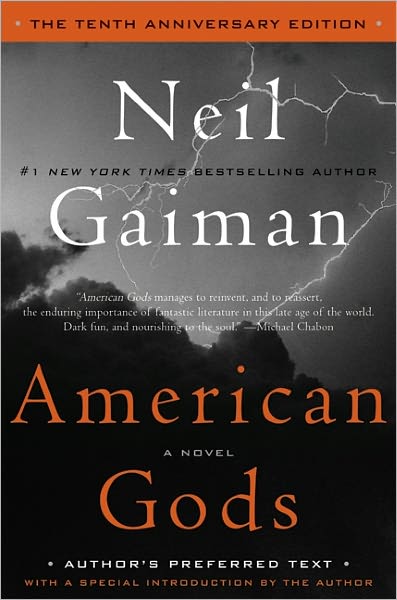
June 19th is the tenth anniversary of the release of Neil Gaiman's American Gods
. Not many novels have their anniversaries celebrated and so I couldn't resist reading it right now (not to mention the number of times that it's been recommended to me by many of you readers when I show it on my TBR list). Now that I've finished, I can definitely understand the celebration of this novel as an essential piece of the American literary canon.
Shadow is a convict, getting ready to finish his sentence and head home to his beautiful wife. He ends up being released early though due to his wife's accidental death, and on his way home he is approached by a mysterious older gentleman who calls himself Mr. Wednesday. Soon after, Shadow is working for Wednesday and moving back and forth across America, meeting other strange characters and discovering that the new world may have more ties to the old than he ever could have believed.
There were parts of this story that were difficult to read because of their graphic nature (violent and sexual). There were other parts that were uplifting and beautiful. The characters (including many gods, as you can guess by the title) were fascinating and diverse. I couldn't put this one down and I was constantly amazed by the way that Gaiman pieced together so many myths and histories in a subtle and seamless way. When I started the book, I wasn't even sure I would like it but, by the end, I was convinced that it is the kind of novel that changes you as you read it. It won't change your beliefs but rather will cause you to question if you should believe or not. I plan to brush up on world mythologies and then to read the anniversary edition of this novel which is longer and is Gaiman's "preferred edition". There will be a live webchat with Neil Gaiman about the novel on June 21st (I don't see a time listed yet but will update if I find one), the day the anniversary edition is released.
This is another of my reads for the Once Upon a Time V Challenge.
Saying a little prayer, just in case,
K
Support our site and buy American Gods: The Tenth Anniversary Edition: A Novel
on Amazon or find it at your local library. We bought our own copy of this novel.
Shadow is a convict, getting ready to finish his sentence and head home to his beautiful wife. He ends up being released early though due to his wife's accidental death, and on his way home he is approached by a mysterious older gentleman who calls himself Mr. Wednesday. Soon after, Shadow is working for Wednesday and moving back and forth across America, meeting other strange characters and discovering that the new world may have more ties to the old than he ever could have believed.
There were parts of this story that were difficult to read because of their graphic nature (violent and sexual). There were other parts that were uplifting and beautiful. The characters (including many gods, as you can guess by the title) were fascinating and diverse. I couldn't put this one down and I was constantly amazed by the way that Gaiman pieced together so many myths and histories in a subtle and seamless way. When I started the book, I wasn't even sure I would like it but, by the end, I was convinced that it is the kind of novel that changes you as you read it. It won't change your beliefs but rather will cause you to question if you should believe or not. I plan to brush up on world mythologies and then to read the anniversary edition of this novel which is longer and is Gaiman's "preferred edition". There will be a live webchat with Neil Gaiman about the novel on June 21st (I don't see a time listed yet but will update if I find one), the day the anniversary edition is released.
This is another of my reads for the Once Upon a Time V Challenge.
Saying a little prayer, just in case,
K
Support our site and buy American Gods: The Tenth Anniversary Edition: A Novel
Thursday, March 3, 2011
"There was once a young man who wished to gain his Heart's Desire."
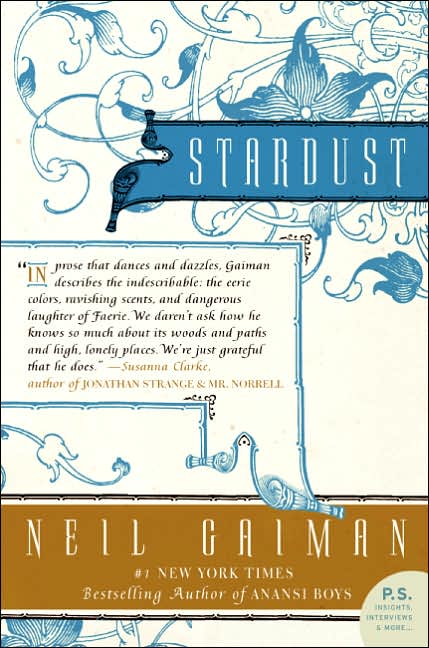
As I sit down to write about Stardust
, I find I don't have much to say because it was just a simple pleasure. So here are a few simple thoughts about this novel --
If you enjoy fantasy of any sort, this is probably an essential read.
If you like or love Neil Gaiman, this is a perfect book for working on the Gaiman narrator voice inside your head. It definitely has the feel of an oral tale and reading it in his voice gives it a very unique cadence.
I want to revisit this world in another story.
This Harper Perennial cover is absolutely beautiful. I don't want to put it away yet.
I'm not sure I've ever seen real violet eyes but I wish I had them.
There is no way that Yvaine should be played by Claire Danes and Ben Barnes should have played Tristran. And his name shouldn't have been changed to Tristan. I don't think I'm going to watch the film.
Basking in the glow of the moon,
K
Support our site and buy Stardust
on Amazon or find it at your local library. We bought our own copy of this book.
If you enjoy fantasy of any sort, this is probably an essential read.
If you like or love Neil Gaiman, this is a perfect book for working on the Gaiman narrator voice inside your head. It definitely has the feel of an oral tale and reading it in his voice gives it a very unique cadence.
I want to revisit this world in another story.
This Harper Perennial cover is absolutely beautiful. I don't want to put it away yet.
I'm not sure I've ever seen real violet eyes but I wish I had them.
There is no way that Yvaine should be played by Claire Danes and Ben Barnes should have played Tristran. And his name shouldn't have been changed to Tristan. I don't think I'm going to watch the film.
Basking in the glow of the moon,
K
Support our site and buy Stardust
Subscribe to:
Posts (Atom)