Showing posts with label novella. Show all posts
Wednesday, January 22, 2014
Long-Awaited Reads Month: The Final Solution
Some of us are thinking about Sherlock Holmes more than is perhaps seemly these days and so it seemed a good time to finally grab this very short novella, The Final Solution: A Story of Detection, off my shelves. I should have known after prior experience that Michael Chabon would pen a story both emotional and intelligent, this being the tale of the unnamed detective's decline into being, well, simply something less than he once was.
Though his name is never spoken, our elderly recluse with a stellar reputation and a penchant for bees is obviously none other than Sherlock Holmes. And when he is asked to look into a murder and the disappearance of a beloved bird, he attempts to step back into his well-accustomed role. And while it's true that he is still more capable than most anyone else, he also starts to experience the new limitations of his body and mind.
This was such a beautiful meditation on Holmes and his legacy and his inevitable decline. One can only muse on what it would be like to lose even a touch of one's genius to the aging process. It almost makes one understand why Holmes would choose to die young if given the chance (or would he?).
Unraveling the mystery of identity,
K
Wednesday, January 8, 2014
Wilkie in Winter: The Frozen Deep
![]() |
| from Dickens and Showbiz site |
As one of two reads for Wilkie in Winter, I was looking forward to this one because I hadn't read it but I had learned some of the background about it through various sources. The Frozen Deep was first written as a play in 1856 and then released as a novella in 1874. Charles Dickens had a hand in it as well, both by coming up with the original idea and also by editing it later. I was tempted to read the play version but decided on the novella instead. It still read somewhat like a play, quite simple with mostly dialogue and only a few bits of scene-setting.
I thought it worked fairly well as a novella but I have to admit that I now have a greater desire to see it performed as a play. It is a very emotional and intense story and I think that would come through much more if it was well-acted. I enjoyed the themes of love, clairvoyance and self-sacrifice and thought there was just enough of a twist to keep it interesting. I would also love to see the period polar exploration costumes. Perhaps there will be a revival of the play for the bicentennial?
Enduring the chill,
K
Monday, January 28, 2013
Cheerful is in the Eye of the Beholder
I had just added Cheerful Weather for the Wedding to my movie queue when Simon suggested that there be a read-along of the 1932 novella by Julia Strachey. I couldn't say no to that and so, while getting my hair cut and colored last week on a typically dreary January afternoon, I was surprisingly transported away to a sunny March day with blustery winds, where I waited (somewhat) patiently with a unique cast of characters for Dolly Thatcham's wedding to begin.
(Note: as the characters are pretty much the main attraction of this story, this post will be a bit spoilery.)
As we wait in the long hall, I find myself sympathizing with thirteen year-old Robert as his older brother Tom harasses him for ::gulp:: having on the wrong socks. Tom has always been so bossy and stuffy, hasn't he? I cringe to see Kitty, younger sister to the bride, acting all of her awkward self in a dress that doesn't look half as good on her as it does on dear Evelyn. I mean, yellow is a gorgeous color for the spring but it doesn't suit everyone, does it? And not to speak ill of the hostess but I swear that Mrs. Thatcham gets more dotty with every passing year. Even I heard her tell poor Millman to set up the luncheon in the library. Oh, and then there's that tragic young anthropologist Joseph sitting in the other room. I know that he and Dolly spent a lot of time together last summer but I can't recall ever thinking they were "together" exactly. Well, it seems like he might have been sweet on her after all. Was that a tortoise that just passed by the window? How bizarre! And who are all of these people flowing in to luncheon now? Cousin Lob, Canon Dakin, Aunt Bella -- what a diverse and amusing family. It makes up for this dreadfully blustery day. I hope the wedding itself is half as entertaining as the morning has been.
![]() |
| Dolly and Owen |
Because this novella does focus so strongly on characters, with only a bit of action right toward the end, I'm a bit worried about the movie version. Looking at the cast list, they've added characters and obviously taken some of the implied situations from Dolly's past and built them up into the bulk of the movie. However, most of the appeal of the novella was in not knowing everything and in having the drama being a bit of a non-starter. How close were Joseph and Dolly really? Is what he revealed to her mother at the end of the story true? Or was this simply a case of him feeling upset that he didn't open up when he had the chance? What if they had a few more moments alone before the Canon came along? I think I'll likely postpone watching the film for a bit to put some distance between it and this well-crafted story.
Feeling not the slightest bit cheerful despite the weather,
K
Monday, May 30, 2011
"Now that I'm dead I know everything."
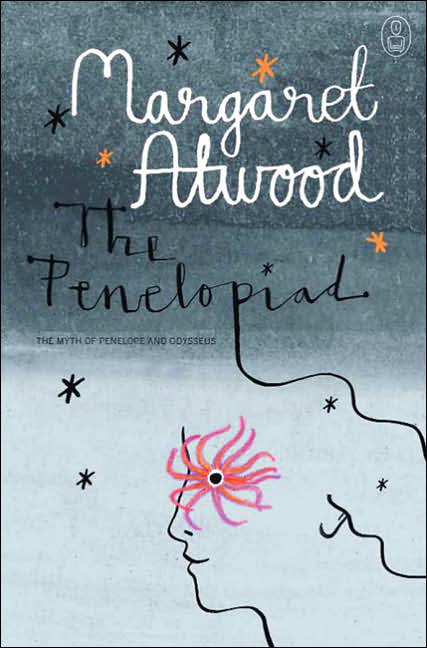
A couple of weeks ago, Bellezza and Col decided to read Margaret Atwood's The Penelopiad
together and invited anyone who wanted to join them. I've had this one on the shelf for a while in a box set with a couple of other books in the Canongate Myths series. The purpose of this series is to "[retell] a myth in a contemporary and memorable way". As I had yet to remove the plastic wrap from the box, I took advantage of the opportunity to fit this slim volume into my reading schedule.
The Penelopiad is a retelling of the Odysseus myth from two alternate points of view -- that of Penelope, Odysseus' wife, and, in the form of a Greek chorus, that of the twelve servant girls that were hung when Odysseus returned from his voyage. Penelope's portion is told from a modern point of view and in a semi-modern voice, as she walks eternally through the fields of asphodel in the afterlife. She begins with her birth, then her marriage to Odysseus and finally her long wait while he was away for twenty years. She tells which portions of the myth were accurate and which were a misinterpretation of the actual facts.
I thought this was a clever little novella that seemed to lose its way a bit toward the end when it delved too much into modern day feminist interpretations of Odysseus' behavior. As The Odyssey is one of my favorite stories, I was a bit concerned about the possible demonization of Odysseus but I thought that Penelope was quite fair in her descriptions of him. The chorus of dead servant girls, on the other hand, were less amusing and I wasn't sure whether they were trustworthy or just vindictive and angry in their interpretations of events. I'll be interested to see how the other readers in the group felt about this.
I think that the book contains enough summary information to be readable even by those who haven't read The Odyssey or are only generally familiar with the story. But, as you can imagine, the story is enhanced with a deeper knowledge of the original myth.
Skirting Charybdis,
K
Support our site and buy The Penelopiad: The Myth of Penelope and Odysseus on Amazon or find it at your local library. We bought our own copy.
The Penelopiad is a retelling of the Odysseus myth from two alternate points of view -- that of Penelope, Odysseus' wife, and, in the form of a Greek chorus, that of the twelve servant girls that were hung when Odysseus returned from his voyage. Penelope's portion is told from a modern point of view and in a semi-modern voice, as she walks eternally through the fields of asphodel in the afterlife. She begins with her birth, then her marriage to Odysseus and finally her long wait while he was away for twenty years. She tells which portions of the myth were accurate and which were a misinterpretation of the actual facts.
I thought this was a clever little novella that seemed to lose its way a bit toward the end when it delved too much into modern day feminist interpretations of Odysseus' behavior. As The Odyssey is one of my favorite stories, I was a bit concerned about the possible demonization of Odysseus but I thought that Penelope was quite fair in her descriptions of him. The chorus of dead servant girls, on the other hand, were less amusing and I wasn't sure whether they were trustworthy or just vindictive and angry in their interpretations of events. I'll be interested to see how the other readers in the group felt about this.
I think that the book contains enough summary information to be readable even by those who haven't read The Odyssey or are only generally familiar with the story. But, as you can imagine, the story is enhanced with a deeper knowledge of the original myth.
Skirting Charybdis,
K
Support our site and buy The Penelopiad: The Myth of Penelope and Odysseus on Amazon or find it at your local library. We bought our own copy.
Tuesday, December 14, 2010
"On an island so far north that it snowed from September to April, a boy named Frederik kept himself warm by keeping a secret."
This book is one that I've been saving for almost a year to read this Christmas -- Matchless
by Gregory Maguire, subtitled An Illumination of Hans Christian Andersen's Classic "The Little Match Girl". This is a small little volume that takes the story of The Little Match Girl, moves it from New Year's Eve to Christmas Eve and adds a surrounding story to it to give it a context that will move even the most cynical reader. It was originally read aloud on NPR by the author in 2008.
I hadn't read Andersen's original story (read it online) in many years and couldn't remember much of how it was told except for the tragic ending. It begins like this --
It was terribly cold and nearly dark on the last evening of the old year, and the snow was falling fast. In the cold and the darkness, a poor little girl, with bare head and naked feet, roamed through the streets. It is true she had on a pair of slippers when she left home, but they were not of much use. They were very large, so large, indeed, that they had belonged to her mother, and the poor little creature had lost them in running across the street to avoid two carriages that were rolling along at a terrible rate. One of the slippers she could not find, and a boy seized upon the other and ran away with it, saying that he could use it as a cradle, when he had children of his own.Matchless adds the story of that boy -- the one who took the lost slipper home. He is named Frederik and he lives out on an island in the harbor of a northern town. The island is connected to the land by a stone walkway. Frederik lives there with his mother and they are poor but surviving. Frederik has a secret miniature town in the attic which he collects bits and pieces around the real town to create. This is why he is anxious to get the slipper when he finds it in the street.
The nameless Match Girl's fate remains the same in her portion of this story but it is sandwiched between Frederik's story, one of hope and purpose even after devastating loss. This is a bittersweet story that reminds readers to remember those less fortunate than they and to temper their indulgences with gratitude and charity. It is a story that I'm sure I will find myself reading each year as the holidays approach.
Lifting head and heart,
K
Support our site and buy Matchless: A Christmas Story
Sunday, May 16, 2010
NYRB Spotlight Series: Great Granny Webster
This week I'm participating in the Spotlight Series and the featured publisher is NYRB (New York Review Books). They have three labels -- Classics, Collections and Children's Collection. From their About page ...
The NYRB Classics series is designedly and determinedly exploratory and eclectic, a mix of fiction and non-fiction from different eras and times and of various sorts. The series includes nineteenth century novels and experimental novels, reportage and belles lettres, tell-all memoirs and learned studies, established classics and cult favorites, literature high, low, unsuspected, and unheard of. NYRB Classics are, to a large degree, discoveries, the kind of books that people typically run into outside of the classroom and then remember for life.
The New York Review Children’s Collection began in 2003 in an attempt to reward readers who have long wished for the return of their favorite titles and to introduce those books to a new generation of readers. The line publishes picture books for preschoolers through to chapter books and novels for older children.
I decided to feature one Classics book and one Children's Collection book and I'm starting today with the novella Great Granny Webster by Caroline Blackwood (108 pages). It's a thinly-veiled autobiographical tale that exposes the reader to an unusual family -- beginning with the rigid and humorless Great Granny Webster. There's little in the way of plot in this book -- merely vignettes during the life of the narrator, who remains unnamed, and the lives of her familial predecessors. She begins the book just two years after the Second World War as a school-age girl, sent to her great-grandmother's house near Brighton to recover from an illness. Great Granny Webster is very old and rather set in her ways and our narrator is relieved when her recovery time comes to an end and she is able to leave Granny's cold and musty home. In fact, this is the end of her contact ever with Granny and yet she can't help but wonder about this woman for years to come. Was she always the same strict woman as she was in her later years? How did her behavior and attitudes affect her daughter, the narrator's grandmother? And why did the narrator's father choose to visit this old crank during the war instead of spending time with his friends?
This was a fascinating book and I was sorry that it was so short. And yet, it also seemed complete in its purpose -- to reveal the similarities and differences within generations of a family. The introduction by Honor Moore was also very well written and added to my experience with the book. It gave some brief biographical information about Blackwood and provided the context that one might have known about the socialite author at the time the book was written. I will leave you with the strong opening paragraph of the book and hope that it sparks your interest in Great Granny Webster.
K
Support our site and buy Great Granny Webster
on Amazon or find it at your local library. We borrowed our copy from the library.
This was a fascinating book and I was sorry that it was so short. And yet, it also seemed complete in its purpose -- to reveal the similarities and differences within generations of a family. The introduction by Honor Moore was also very well written and added to my experience with the book. It gave some brief biographical information about Blackwood and provided the context that one might have known about the socialite author at the time the book was written. I will leave you with the strong opening paragraph of the book and hope that it sparks your interest in Great Granny Webster.
I was sent to stay with her two years after the war had ended, but in her house it seemed to be war-time. Her blinds and curtains were often drawn even during the day as if she was still preserving some kind of conscientious "black-out". I think she was more frightened of the sun than she had ever been of German raids. She owned gloomy and valuable Persian carpets and it seemed to be her terror that some stray and sneaking sunbeam would creep in and make them fade.Pondering the ties of blood,
K
Support our site and buy Great Granny Webster
Monday, January 25, 2010
"We called him the Professor."
You're probably about to see a number of reviews around for Yoko Ogawa's short novel The Housekeeper and the Professor. It was this month's selection for the Japanese Lit Group and it's a wonderful book.
A story of everyday life featuring not so ordinary characters, this book is told from the point of view of the "housekeeper" -- a nameless woman whose difficult upbringing and young pregnancy has given her very little advantage in life. She receives a new assignment one day to work for the "Professor". He lives in a cottage adjacent to the home of his sister-in-law and has a unique brain injury from a car accident years before -- his short-term memory only lasts for eighty minutes. He wears a suit covered in small notes that remind him of the little things in life. He is a difficult assignment in some ways but easy in others, in that he spends most of his time working on mathematical problems that he finds in a magazine. The housekeeper is fascinated with him and with the way he introduces her to the world of numbers and mathematics. When he insists that her ten year old son also come to the house after school, a unique relationship is formed between the three people. And yet, the question remains if they have a true friendship or not due to his limitations.
I am finding it hard to choose the right words for this discussion. It is a touching story that is unique in its exploration of friendship, motherhood and a life that is anything but ordinary. I was surprised by how deep this book went in such a short time. I really felt like I knew these people and understood their trials and lives. This is also a new view of modern Japanese life for me -- complete with small details like meals and weather. I enjoyed these aspects of the book just as much as the characters. Finally, as I try to remember to do in any stellar translated work that I read, I also want to give credit to Stephen Snyder, the translator for this novel. This book is very accessible to all readers.
Living a life segment of my own,
K
Support our site and buy The Housekeeper and the Professor
on Amazon or find it at your local library. We bought our own copy.
A story of everyday life featuring not so ordinary characters, this book is told from the point of view of the "housekeeper" -- a nameless woman whose difficult upbringing and young pregnancy has given her very little advantage in life. She receives a new assignment one day to work for the "Professor". He lives in a cottage adjacent to the home of his sister-in-law and has a unique brain injury from a car accident years before -- his short-term memory only lasts for eighty minutes. He wears a suit covered in small notes that remind him of the little things in life. He is a difficult assignment in some ways but easy in others, in that he spends most of his time working on mathematical problems that he finds in a magazine. The housekeeper is fascinated with him and with the way he introduces her to the world of numbers and mathematics. When he insists that her ten year old son also come to the house after school, a unique relationship is formed between the three people. And yet, the question remains if they have a true friendship or not due to his limitations.
I am finding it hard to choose the right words for this discussion. It is a touching story that is unique in its exploration of friendship, motherhood and a life that is anything but ordinary. I was surprised by how deep this book went in such a short time. I really felt like I knew these people and understood their trials and lives. This is also a new view of modern Japanese life for me -- complete with small details like meals and weather. I enjoyed these aspects of the book just as much as the characters. Finally, as I try to remember to do in any stellar translated work that I read, I also want to give credit to Stephen Snyder, the translator for this novel. This book is very accessible to all readers.
Living a life segment of my own,
K
Support our site and buy The Housekeeper and the Professor
Friday, January 8, 2010
Poe Fridays: The Narrative of Arthur Gordon Pym of Nantucket
Welcome back to Poe Fridays. For this week's discussion we tackled Poe's longest story, the novella-length The Narrative of Arthur Gordon Pym of Nantucket. You can read it here.So, I have to say that this was a lot less painful than I was led to believe it would be. It got a bit silly toward the end and I skimmed a bit when he started getting too technical on cargo holds or bird rookeries but, overall, it was just an adventure story. Our main character is a young man who sets out to sea against the wishes of his family. The gist of the story is that he would have been better off staying at home. Just about any calamity that can befall one at sea, happens to our poor lad.
On a tangent, I was interested to read that one of the boy's ships chose to look for the Aurora Islands. I learned about them when I read Hippolyte's Island this past year -- the story of a man who travels alone to the islands, finds them and then returns home to write about his journey. I didn't know that they were an actual set of phantom islands.
With next week being our last Friday before Poe's birthday and therefore our last Poe Friday (although I will post a summary of everything I read on the following Friday), I am offering it as a free day -- choose whatever Poe poem or story you would like to read and write about. Maybe there was something that we have already read that you loved and want to re-read? Or have you just been following along and would like to choose one thing to read before this ends? Perhaps I've even skipped one of your favorite Poe writings and you want to remedy it now. Whatever the case, I would love to see some participation next Friday for our final celebration of this great author. And if you were wondering, I haven't decided yet what I'm going to read but I think it might be a re-read!
Choosing to stick to dry land,
K
Thursday, August 6, 2009
"At Windsor it was the evening of the state banquet ..."
The brief summary of this book is that the Queen's corgis go for a run and find the mobile library parked near the back of the palace. She steps in to apologize for their vocal assault on the truck and then feels obligated to borrow a book. The next week, she decides to go in person to return the book and ends up choosing another. Her interest in books grows and she starts spending all of her free time reading. For various reasons, most of her staff and family don't approve and she must analyze why she has decided to become a reader at this point in her life.
This was an incredibly sweet and yet honest look at a very private woman. It is of course fictional and therefore Bennett was free to take some liberties but I would assume that if he had taken anything too far, we wouldn't be reading this novella! I will leave you with a passage that I found quite amusing and yet it has some poignant social insight.
The librarian at Windsor had been one of many who had urged on Her Majesty the charms of Jane Austen, but being told on all sides how much ma'am would like her books put ma'am off altogether. Besides, she had handicaps as a reader of Jane Austen that were peculiarly her own. The essence of Jane Austen lies in minute social distinctions, distinctions which the Queen's unique position made it difficult for her to grasp. There was such a chasm between the monarch and even her grandest subject that the social differences beyond that were somewhat telescoped. So the social distinctions of which Jane Austen made so much seemed of even less consequence to the Queen than they did to the ordinary reader, thus making the novels much harder going."
Wondering what makes me a reader and what being a reader makes me,
K
Support our site and buy The Uncommon Reader
Subscribe to:
Posts (Atom)