Showing posts with label book group. Show all posts

Monday, August 23, 2010

Japanese Book Group: Kitchen

The current read for the Japanese Book Group, hosted by Tanabata of In Spring It Is The Dawn, was a choice of Kitchen and/or Goodbye Tsugumi by Banana Yoshimoto (real name Mahoko Yoshimoto).  I chose Kitchen which is actually a book with two stories of loss -- one called Kitchen and one called Moonlight Shadow.

The first is about Mikage Sakurai, a university student who has just lost her last family member -- her grandmother.  A young man who attends the funeral, Yuichi Tanabe, invites Mikage to stay with him at his mother's home until she is ready to be on her own again.  When Yuichi also loses his only family, they need to decide if they have a relationship because of loneliness or love.

The second story, actually written first in 1986, is about another young woman named Satsuki.  Her boyfriend of four years has just died in a car accident while driving his younger brother's girlfriend home.  Satsuki and Hiiragi are both trying to come to terms with such a large loss so early in life.  But a mysterious visitor may help them gain some sense of closure.

These were both very tragic but real stories of life.  I liked the stories for the most part, especially the slightly supernatural element of Moonlight Shadow, but sadly not the translation of Kitchen.  I thought it was awkward in places and sometimes read more like a literal translation than a literary one.  There is an interesting interview with Michael Emmerich who took over translating Yoshimoto's books after this first one.  It seems that he was less than satisfied with Megan Backus' translation as well.  Another issue I had was that the kitchen metaphor didn't seem very strong even though it was the backbone of the first story.  This was a shortcoming on the part of the author though.

Because this was Yoshimoto's first published work, I am interested to see how her style and subject matter change over the years.  I will definitely read more of her works.  Again, I want to thank Tanabata for encouraging me to read more Japanese novels with her challenges!

Exploring the depths of grief,
K


Support our site and buy Kitchen on Amazon or find it at your local library.  We borrowed a copy from the library.

Sunday, May 23, 2010

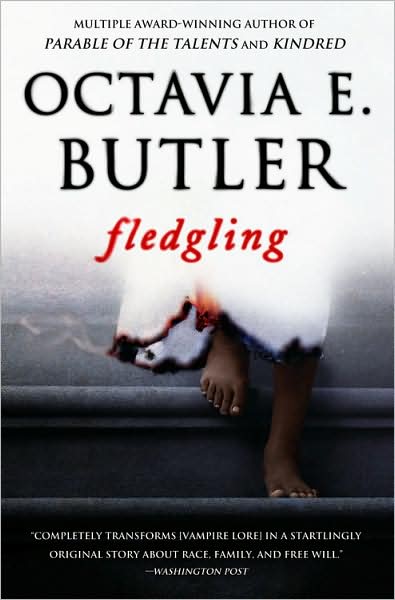
Book Club Read: Fledgling

The final read in this round of the NTTVBG was chosen by Kim of Reading Matters and was Octavia Butler's Fledgling.  All I knew going in was that it was a vampire book.  I decided to read it since I've been curious about Butler for a few years but hadn't picked up any of her books on my own.  She was considered a master of her genre and something of an anomaly in the science fiction/fantasy world because she was an African-American woman.  This was a very interesting choice for this particular book group and I'm interested to join in the discussion with everyone today.

Briefly, this is the story of a young member of a vampiric race, the Ina, that co-exists with humans.  They do not change anyone into vampires when they bite them but, instead, give pleasure to humans with their bites and become attached to them in a symbiotic relationship.  This young Ina has survived an attack on her colony but has lost her memory of anything before the attack.  She must re-learn what it means to be Ina, how to interact with her symbionts and why she is unique among her people.  Her exploration gains a sense of urgency as she realizes that her family was targeted because of her existence and many more will die if she doesn't find out why she is so strongly disliked.

Though this isn't my sort of story, I got through it.  The most distracting thing was the ridiculous number of typos in my version of the book.  The most compelling parts were the politics of this supposedly advanced race and how they still have some weaknesses similar to humans.  The symbiont/Ina relationships were strange and I was creeped out by the eroticism/violence connection -- but then again, that's what you expect with a true vampire story.  I'm not sure if I will explore this author more but supposedly her other novels are quite different from this one except for the similar discussions about race and gender issues.

Moving on to something lighter with less bloodsucking,
K


Support our site and buy Fledgling on Amazon or find it at your local library. We borrowed our copy from the library.

Friday, May 14, 2010

Japanese Literature Read-Along: The Wind-Up Bird Chronicle: Book 3

I've finally reached the end of my three-month journey in The Wind-Up Bird Chronicle.  Thank you to Tanabata for choosing this for the Japanese Literature Read-Along.  It was my first experience with Haruki Murakami and I enjoyed it for the most part and would love to continue exploring his work.  Again, here are my thoughts on Book 1 and Book 2.

The final section of this book leaves behind some characters, the sisters Kano, and introduces two new ones -- Nutmeg and Cinnamon Akasaka, a mother and son.  Toru Okada is still the focus of the story but we also read many other narratives that are seemingly unrelated to the present.  Some things are tied up in this third book but many are not.

I ended this book with a strange feeling -- neutrality.  I'm not sure if I liked or disliked this book overall.  There were certainly parts I enjoyed and others that made me uncomfortable.  I will have to let the impressions settle for a while longer.  This one might even require a re-read for me to be able to decide.  It was a unique experience and, if this is what it is like to read Murakami, I can see the appeal.  He is no ordinary author.

Silencing the wind-up bird,
K


Support our site and buy The Wind-Up Bird Chronicle on Amazon or find it at your local library. We received our copy from a fellow blogger.

Sunday, April 11, 2010

Book Club Read: Skin Lane

The latest selection by Simon for the Not The TV Book Group was Skin Lane by Neil Bartlett.  I wasn't going to read this one because I didn't think it was a good fit but at the last moment decided to give it a try since Simon must have had a reason for choosing it.  However, this ended up being a Did Not Finish for me at page 130 of 344.

This is the story of a lonely man in his late forties in 1960s London.  He begins to have a recurring nightmare about coming home to his flat to find a young man tied up and dead in his bathroom.  He becomes obsessed because he can't see the face of the victim.  He starts searching London for young men with similar features to those he could see in his dream so that he can put a face to the body.  When he decides he has found the right young man, I stopped reading.  Did I mention that the main character is a furrier?  That he works with many sharp instruments and spends his days cutting the skins of animals?  And that he has just looked longingly at the skin of this certain young man?

This is the point where I didn't want to know any more.  I don't know what direction the novel ends up taking but whatever it is, imagined or real, I didn't want the images in my head that I knew would be inevitable based on the main character's mental instability and already strange thoughts and actions.  The moment I decided to stop reading Skin Lane, I felt a great sense of relief.  I also wasn't thrilled with Bartlett's writing style in this novel which I think contributed to my willingness to stop reading it.

So, I am going to head over to the discussion for this novel and find out why Simon chose it, why it was shortlisted for an award and what the other readers ended up thinking about this disturbing book.

Washing away the mental dirt with a light and lovely novel,
K


We are not going to suggest you buy this book.  If you want to read it, you can do what we did and find a copy at your local library.

Monday, March 15, 2010

Japanese Literature Read-Along: The Wind-Up Bird Chronicle: Book 1

I'm very excited to have the chance to join Tanabata in a three-month long read-along of The Wind-Up Bird Chronicle by Haruki Murakami.  Simon suggested I try Kafka on the Shore first but I ran out of time so this ended up being my first Murakami novel.  I've been interested in it since last year when my husband ran a Facebook application that gathered data from his friends and said that the most frequently listed "favorite" book in his friends group was this one!  Anyway, the group read started with Book One for this month and I finished it just in time.

Told in the first person, we follow Toru Okada, a married man in a Tokyo suburb who has quit his job and is trying to figure out what he wants to do next with his life.  He certainly doesn't want to return to his career in law but he's not sure what else lies in his future.  While he's spending his time at home, his wife gone at work, many things happen to him that are out of the ordinary. He receives strange phone calls from an overly familiarly woman.  His cat goes missing and his wife brings in a psychic to help them find it.  He meets a sixteen-year old neighbor girl who ditches school and does surveys around the city of bald men for a wig-making company.  And this is just the start of many irregular things that happen.  He tries to make sense of all of this but his calm personality also allows things to happen around him and, instead of acting out, he tries to find the reason that these things are coming to him.

I'm really enjoying this book so far.  There are some parts that are a bit over the top but I get the sense that Murakami doesn't write without purpose.  I think that many things will be explained and tied together before the end of the story.  As a main character, Toru Okada is very neutral--he doesn't really initiate anything--and yet he is somehow also quite likable.  Apparently the reader isn't the only one to think this.  Many of his fellow characters find him easy to confide in and seem to trust him immediately.  I am very interested to find out what happens in the rest of the story and it will be hard to wait to find out!

I will be discussing this more today at In Spring It Is The Dawn.

Hoping for a satisfying continuation,
K


Support our site and buy The Wind-Up Bird Chronicle on Amazon or find it at your local library. We received our copy from a fellow blogger.

Sunday, February 21, 2010

Book Club Read: The Girl With Glass Feet

The second read for the Not The TV Book Group was chosen by Simon of Savidge Reads and is The Girl With Glass Feet by Ali Shaw.  I don't know of a better book to promote discussion so this was a great choice.  The book club is meeting today here.

This is the story of the magical and terrible St. Hauda's Land -- where a mythical creature turns other animals white with a glance, tiny moth-winged cattle buzz in a secret pen and Ida Maclaird is slowly turning to glass from the toes up.  But just as prevalent as the impossible are the all too possible failings of the residents of the island.  Midas Crook is one of the most flawed -- unable to view the world except through the lens of a camera, crippled by the memory of his dead father and afraid to be touched.  And yet something magical happens between Ida and Midas and they try their hardest to come together despite everything.

This was a very thought-provoking book.  Midas and Ida were both sympathetic and yet maddening at the same time.  The magical and real are placed side-by-side in this novel in a way that is both comforting and unsettling.  This is a novel of contradictions -- about heredity and about change -- and I'm sure I will be thinking about it for a long time to come.

Feeling the warmth through the hard chill,
K


Support our site and buy The Girl with Glass Feet on Amazon or find it at your local library. We borrowed a copy from the library.

Sunday, February 7, 2010

Book Club Read: Brodeck

The first selection for the Not The TV Book Group was the novel Brodeck by Philippe Claudel and was selected by Lynne at Dovegreyreader Scribbles. The discussion begins today at her blog. I invite you to head over there for the summary and discussion.

Briefly, this is the story of a man (Brodeck) who has been tasked with writing an account of an atrocity that has happened in his town.  He is already scarred by having been found orphaned in the charred remains of his home town (presumably in WWI) and then dragged from his adopted home as a young man by soldiers (in a WWII scenario).  He survives to return home but finds his town changed by the occupation of the soldiers and, eventually, the arrival of a stranger in town (the Anderer) triggers a series of shameful events.  Brodeck decides that along with the official report he was asked to write (to provide justification for the town's acts), he is going to write his own story and the full version of events.  This is what we are reading in the novel.

This was a heartbreaking story that rang too true.  Though there was an assumed time frame, this story had a definite fluidity of time that gave it the ability to apply to almost any period of hatred and fear in world history. I believe that the message of the book is that emotions do not end with a conflict.  The signing of a treaty does nothing to change the evil already sown in men's hearts.  There remains a heightened awareness of those who are different and those who were ostracized.  There also remains the ability to perform horrific acts once the mental barriers to them have been brought down.

This book lends itself to much discussion so if you are interested, find a copy and head over to the discussion which will be ongoing.  It's called Brodeck in the U.S. and Brodeck's Report in the U.K.  It is translated from the author's native French.

Quiet with introspection and sadness,
K


Support our site and buy Brodeck on Amazon or find it at your local library. We borrowed our copy from the library.

Monday, November 30, 2009

Japanese Book Group: The Old Capital

Tanabata of In Spring it is the Dawn has started a Japanese Literature Book Group. As I have never read any Japanese literature, I thought this was a great way to start without the pressure of having to choose my own books. A new book will be chosen every two months and the inaugural choice was The Old Capital by Nobel Prize winning author Yasunari Kawabata.

This short book (160 pages) is actually two stories in one -- the coming of age of Chieko, a girl who follows the traditions of the past, and the inevitable aging of the ancient city of Kyoto, Japan's one-time capital. As Chieko contemplates her future and that of her own aging parents, she is confronted with information about her past that may change everything for her. We follow Chieko and her father as they explore the traditional sites of Kyoto and participate in some of the many festivals and rituals still performed even in the early 1960s.

There was so much to learn in my first literary introduction to Japan. The first thing I noticed was that Japanese does not necessarily translate smoothly to English. Many of the strange phrasings and cadences that you hear in translated Japanese animated films were also present in this book. So in a way it was familiar but only in an obviously inaccurate manner. Secondly, the pacing and movement of time in the book was much different than in Western literature. The foreword in my edition said that this story was originally published in the daily newspaper in 100 installments. I would have been really interested to see where the breaks were between installments. I think it might have brought more sense to the pacing of the book. Finally, this book gave me a definite interest in finding out more about Kyoto -- both its past and the current state of the city. It was definitely one of the most interesting characters in the story -- especially since I had problems connecting with Chieko.

The next book group selection is one that was already on my TBR list-- The Housekeeper and the Professor by Yoko Ogawa --so I will definitely be participating again.

Embarking on a literary journey,
K


Support our site and buy The Old Capital on Amazon or find it at your local library. We borrowed our copy from the library.