Showing posts with label technology. Show all posts

Saturday, February 18, 2017

New-ish Release: The Great Derangement


After I decided to make climate change and the environment my issue, I searched "climate change" on my library system webpage and first got a lot of either kid books or books that looked overly alarmist. Then I was surprised to see a recent book by a well-known novelist, Amitav Ghosh. The Great Derangement: Climate Change and the Unthinkable, is based on four lectures that Ghosh gave at the University of Chicago in 2015. It's a short book--only 160 pages--but I'm still absorbing and thinking about its ideas weeks later.

The book is divided into three parts. The first, which takes up half the book, is called Stories and it mainly explores the current state of fiction and literature and why Ghosh believes it rarely addresses climate change even though this is something looming quite large on our human horizon. He wonders why books that work all-too-real future scenarios into their plots are immediately shunted off into the fantastical bin of science fiction. He also tells his own story of being caught in a freak weather event as a young man and how this underlying story in his life has occasionally surfaced in his own fiction. This section of the book was frankly completely unexpected but utterly fascinating as a reader and I can only imagine it would be even more so for a writer. The details are explored in both his home country of India and his adopted home of New York City and it was eye-opening to explore the problem of climate change perception from opposite sides of the globe.

The second part of the book is called History and was equally fascinating. Finding out little known tidbits about Asian history (like the history of oil production in Burma) and exploring the effects of colonialism on emerging carbon-based economies was yet another aspect of climate change that I had never considered. One tends to gloss over the past and look to the future for solutions but an understanding of the past enhances the picture of what we are facing and why.

The final part of the book is Politics and was every bit as disheartening and frustrating as you might imagine. I was honestly in tears while reading one passage that voiced the futility of many of our efforts as individuals and citizens because of the far-stronger forces of corporations whose interests do not line up with an effort to combat climate change. As I was making calls to my Senators denouncing a political appointee who obviously detested the organization that he was about to head, I was forced to acknowledge that my voice would never be as loud as the dollars that were flowing in to the opposing party from powerful fossil fuel barons. I honestly set down the book at that point and questioned my choice to choose this issue as my battleground. But eventually I picked it up again and found small glimmers of hope -- from the words of Pope Francis in his Encyclical Laudato Si' in regards to our stewardship of the Earth to the ability of the U.S. Defense Department to ignore the politics of the day and focus on the real effects climate change will have on our nation and world.

This book is not an easy read, probably more so because it doesn't delve into any of the unemotional science of climate change but rather into the souls, imaginations, and intentions of flawed humans. But, if we are to survive the Great Derangement--this time when we focus too much on self when a global viewpoint is essential to survival as a species--we need a change in attitude and focus as much as we need technological innovation. I am grateful to Ghosh for tackling this tough subject in a completely unique way.

Turning my inner eye outward,
K

Monday, January 21, 2013

New Release: Mr. Penumbra's 24-Hour Bookstore


You've likely already heard of this unique new novel, Mr. Penumbra's 24-Hour Bookstore by Robin Sloan, with its glow-in-the-dark cover and its celebration of books. It made a lot of "best of" lists last year and I was very excited to get it for Christmas.

Clay Jannon is an unemployed web designer in San Francisco who happens into a random bookstore, Mr. Penumbra's 24-Hour Bookstore, that has a "help wanted" sign in the window. Without much effort but, perhaps, a bit of destiny, Clay ends up with the night shift at the bookstore. It's a mysterious place with regular books in the front and towering shelves of strange volumes in the back. What those books are for and what the bizarre customers who come in at all hours are after is for the reader to discover alongside Clay.

I'll be honest and say that I really liked this book but didn't love it. I can't put my finger on it but there was something missing from it. Maybe it was heart? Most of the character interactions were plot-advancing with little character building. I also thought the Google fandom was a bit strong. It reminded me of Microserfs by Douglas Coupland in its attempt to humanize a corporation. But, where Microserfs was able to portray its employees as hard-working, barefoot, Lego-loving nerds, this story gave the impression that Google employees are overworked, obsessive-compulsive misfits who have every moment of every day, down to what nutrients they eat, micromanaged by their employer. It made me a bit sad. While this novel was seemingly meant to celebrate intelligence and individuality--the soul, if you will--it just served to reinforce the loss of such things in today's corporate world, regardless of the outward face they put on. Still, there were some unique and unforgettable characters and events in the book and overall I enjoyed reading it. I just wish it had been a bit, well, more.

Finding the soul of each book,
K

Tuesday, January 3, 2012

A Literary Love Letter to Matthew Pearl

Dear Matthew Pearl,

Many years ago, when I used to find my next read solely by wandering the aisles of my local Barnes & Noble, I happened upon your first novel -- The Dante Club.


I thought it was a fantastic book, putting well-known American authors Longfellow, Holmes and Lowell in a shockingly dark adventure based on the writings of Dante. I liked it so much that I gave it to my mom to read and she liked it too (except for the part about the maggots which she still brings up every once in a while as being just a bit too vivid and memorable). The only problem was that I didn't know much about these authors before reading the book and so, while I had a great time with the story, it didn't mean quite as much as if those authors had been literary "friends" of mine.


Then, in 2006, I was thrilled to find that your next novel did feature a chum of mine, a recently deceased Edgar Allan Poe. The Poe Shadow is about a very likable young lawyer, Quentin Clark, who can't believe the rumors flying about Poe after his untimely death. He follows the clues that many die-hard Poe fans have also followed over the years to try and prove that Poe's bad reputation was not in fact true. It was a fantastic novel that brought an unsolved mystery back to life in vivid color.


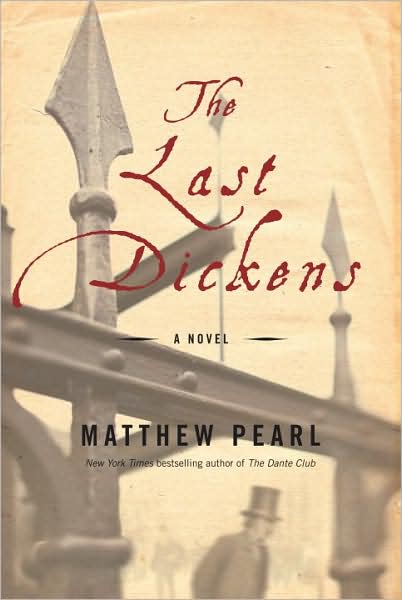
And then, just a couple of years ago, I almost fainted when you tackled the death of my beloved Charles Dickens and the missing ending of his final novel, The Mystery of Edwin Drood. After a less than satisfying experience with another novel about the same subject that came out around the same time, this story turned out to be just what I was looking for. I wasn't disappointed with your book at all.


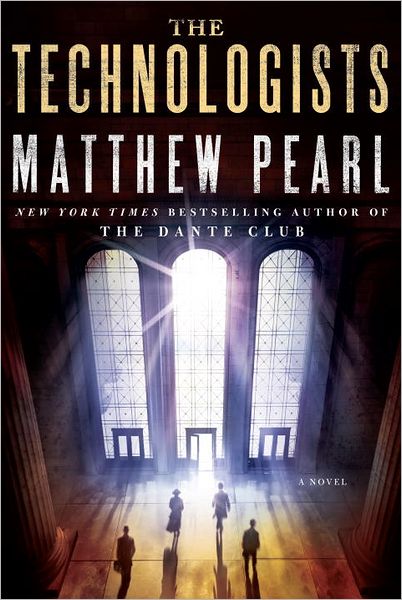
Finally, last month I had the pleasure to read an early copy of The Technologists, which will be coming out in February. Like The Dante Club, I wasn't previously familiar with the characters or setting--the first graduating class of M.I.T., The Massachusetts Institute of Technology--but, by the end of the story, I became more invested in the lives of these young men (and women) than I would have thought possible. In fact, I was disappointed when the book ended because I wanted to follow your characters through the rest of their lives and even back into their pasts. With fascinating studies of science versus religion, Tech versus Harvard, women in education, the Civil War and more, this was a deep and thoughtful book that also read as a love letter to Boston, a city with a long history. And the mystery, oh, the mystery! I almost wrote you half-way through reading the book because I thought I was so clever and had it all figured out. But I was wrong and couldn't have been happier to be so. I didn't feel cheated or misdirected at all. I simply followed the clues, as did Marcus and the other Tech students. Even the best scientist can only form conclusions with the facts he or she has at hand.

And writing a prequel short story, The Professor's Assassin, was a brilliant way to set the stage for why M.I.T. was so important, especially to its founder, William Barton Rogers. It also avoided the increasingly-present Prologue that is starting to bother some readers of modern novels. And now I've just found some novellas and short stories on the website for The Technologists about Marcus, Edwin and Ellen and I'm incredibly excited to read about the students' time at M.I.T. It's exactly what I was wishing for!

One of my reading resolutions for this year is to re-read your first three novels and I may even throw in a re-read of The Technologists at the end of the year for good measure because it was just that good. Thank you for writing books that I want to read over and over. I hope to convince a few other readers to pick them up as well.

Yours in literature and history,
K